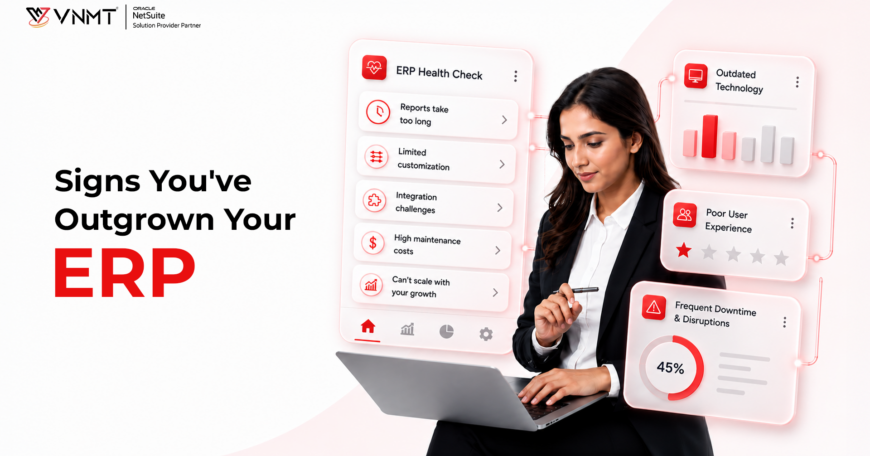

Enterprises in India begin their operations using relatively simple accounting applications, spreadsheets, or even ERP software packages that seem to suffice during the initial years. The application enables basic management of operations as well as maintaining control over operations where there is less data. However, with time, when the business grows, the demand from customers rises, operational activities expand into other geographic regions, and data becomes more complex, these very applications become a hindrance rather than a helpful tool.
The problem with these operations is not effort or ability; rather, it is the limitations of the systems in use. ERP solutions have evolved, but those being used today were not meant for the current complex, fast-paced, and multi-channel environment.
If your enterprise frequently experiences delays, inefficiencies, and data inconsistencies, you should consider hiring an experienced NetSuite solution provider that offers scalable ERP platforms such as NetSuite. The following are some indicators of when you should seek an ERP system replacement.
Top Signs Your Business Is Ready for NetSuite ERP
1. Disconnected Systems and Absence of a Single Point of Reference
One of the early indicators that an ERP is insufficient in capability is the operation of different departments operating independently from each other. Financial and sales departments, as well as inventory management, have separate databases. In the case of unconnected systems-
- Financial reports contain numbers that differ from sales dashboards.
- Late updating of inventory causes inaccuracies in stock levels.
- Management cannot get a full picture of the business.
- Making decisions becomes reliant on manual reconciliations.
Integration issues result in unnecessary delays and a lack of trust in the data. Instead of planning a business strategy, employees need to reconcile differences in numbers. By adopting a more contemporary ERP, organizations can centralize all their information in a single system. Effective NetSuite Implementation Services help businesses transition from legacy systems with minimal disruption while improving operational visibility across departments. Understanding NetSuite Licensing is equally important, as the right licensing structure can help companies manage costs while supporting future growth.
2. Extreme Reliance on Excel and Manual Reporting
If you have come to rely on Excel as your unspoken ERP system, you should be aware that your current system is inadequate. ERP legacy systems sometimes do not provide adequate options for reporting. Therefore, data needs to be exported and manually processed. Signs to look out for include-
- Month-end reports are taking days due to manual reconciliation.
- Duplicate spreadsheets are causing confusion in reporting across teams.
- Multiple versions of the same report are creating data inconsistencies.
- Manual consolidation efforts are slowing business decisions.
In Indian companies, such reliance builds up gradually without anyone realizing it. Over time, employees will find themselves spending more effort preparing reports than analyzing them.
An efficient ERP system can solve the problem completely with its real-time dashboards and automated reporting structures.
3. Inventory Discrepancies and Supply Chain Visibility Gaps
The more a business grows, the harder it gets to manage its inventory. ERP systems that have been around for some time may not be capable of giving up-to-date visibility across all warehouses, suppliers, and logistics. This results in-
- Stock-outs caused by inaccurate demand forecasting.
- Overstocking of products, tying up working capital unnecessarily.
- Delayed shipment notifications cause a gap in the chain.
- Limited visibility from several warehouse locations.
In India, where logistics operations often involve multiple warehouses, interstate movement, and complex supplier networks, visibility issues can quickly disrupt business operations. Industries such as manufacturing, retail, distribution, wholesale, and e-commerce are especially affected because they rely heavily on accurate inventory tracking and timely supply chain coordination. Modern ERP systems help improve inventory visibility and operational accuracy, but the larger issue usually comes from relying on outdated ERP solutions that cannot support growing business complexity.
4. Scaling up Seems Difficult in Terms of System Capacity
Scaling should not be seen as an obstacle, but a natural opportunity. However, there are numerous cases where scaling leads to the discovery that the existing system does not support it. Indicators include-
- Reduction in system performance with additional users.
- Inability to add branches or business units.
- Inability to operate with multiple locations.
- High dependence on IT staff even for minor configuration adjustments.
Rather than facilitating growth, the system becomes the limiting factor. Organizations are forced to adapt their processes based on system limitations rather than scaling as desired.
This is the point where organizations start seeking out a NetSuite Solution Provider.
Read More: Choosing the Right NetSuite Solution Provider Partner
5. Late Financial Information Impacting the Decision-Making Process
Financial visibility plays a key role in making decisions. The traditional ERP system uses a batch-processing technique that makes the reports available only after a specific period of time. Issues that might arise due to late financial information include-
- Lack of information regarding cash flow position
- Incomplete information regarding trends in profitability
- Time-consuming month-end closing process
- Inaccuracies in forecasting due to late information
To manage business operations effectively, leadership teams need access to real-time financial information instead of delayed reports. Outdated ERP systems often lead to delayed decisions, cash-flow uncertainty, reduced visibility into profitability, and slow month-end close processes. A modern ERP system helps solve these challenges by providing live financial reporting and better operational visibility across departments.
6. Integration Problems with Current Technology
Modern companies use multiple software options like CRM, e-commerce, payment systems, and analytical tools. Legacy ERP systems find it difficult to connect with these systems. Some common integration problems include-
- Data entry is done manually from one platform to another.
- Limited support for API or restricted connectivity
- Using external applications for simple integration
- Inconsistency of data and its analysis
Businesses today also expect their ERP systems to integrate seamlessly with widely used applications such as Shopify, Amazon, WooCommerce, Salesforce, HubSpot, Stripe, PayPal, 3PL platforms, and banking systems. When these integrations fail or require constant manual intervention, teams lose productivity, and decision-making becomes slower.
Instead of building a connected digital ecosystem, outdated ERP systems often create fragmented operations and duplicate processes. Modern ERP platforms are designed to support seamless integrations, but legacy systems frequently become the biggest barrier to digital transformation and operational efficiency.
7. Compliance and Regulation in India Becomes Difficult to Handle
Indian companies have their own regulatory requirements, like GST compliance, TDS computation, and state-specific reporting. Traditional ERP systems fail to cope with these issues. Some common problems faced by organizations include-
- Manually handling GST submissions in different states.
- Unable to maintain audited financial records
- Consistent regulatory non-compliance due to manual changes
- No centralized taxation reports
As businesses expand across India, compliance requirements become more complex and difficult to manage manually. Regulations related to e-invoicing, TDS, GST filings, multi-state taxation, and audit trails require accurate and centralized financial data. Without a unified ERP solution, these processes become time-consuming, error-prone, and difficult to track consistently across departments and locations.
Why NetSuite?
With NetSuite, enterprises get a single platform for managing their core functions, including finances, inventory, reporting, and workflow management. Rather than using data in different systems and through various spreadsheets, all accurate data is available on one integrated platform. This makes visibility easier and also helps companies scale up without any additional complexities.
Why Switch Now?
ERP upgrades that get delayed by organizations often result in higher inefficiencies due to challenges like slow reports, disjointed data, inventory issues, and more compliance. In an increasingly competitive market environment, it makes sense for Indian businesses to adopt modern ERP solutions in order to ensure operational efficiency in the long run.
When You Should Consider a NetSuite Solution Provider
If your business is encountering more than one issue mentioned above, then this is already beyond a minor problem. This means that your ERP system is now outdated to meet the needs of your company. It is important at this point to seek the services of a NetSuite solution provider together with an expert ERP implementation partner. They can help you do the following-
- Spot any inefficiency in your current system.
- Develop an ERP roadmap.
- Integrate the business process with the ERP architecture.
- Seamlessly migrate from the old system.
Take the step toward strategic transformation by upgrading to NetSuite today.
Reasons Why Indian Businesses Are Going for NetSuite ERP
Companies operating in India’s manufacturing, retail, distribution, and service sectors are increasingly adopting cloud ERP software solutions due to scalability and visibility considerations. NetSuite is popular since it allows for-
Multiple Locations and their Subsidiaries
It is hard to manage operations at different branches and subsidiaries with an old ERP system. The problem lies in the inconsistency in data and delays in reporting that organizations face. A contemporary ERP system would help streamline operations within various locations while keeping control over finance, inventory, and other compliance issues.
Real-Time Financial and Operational Reports
Nowadays, it is impossible for businesses to wait for delays in reporting to make informed decisions. With real-time financial and operational reporting, business owners get visibility of their financial status, inventory movement, and performance.
Scalability for Growing Companies
When the company grows, its level of complexity becomes much higher. Old systems are unable to work under increasing loads and with an increasing number of departments and employees. A modern ERP system is scalable and can grow together with the company.
Greater Compatibility With Other Tools
Nowadays, all enterprises work with various platforms for CRM, analytics, payroll, e-commerce, and other tasks. In most cases, old ERP systems are not compatible with those tools, which leads to the necessity of duplication of efforts and work with many interfaces.
The trigger for making this shift comes from the fact that firms recognize they need to upgrade their old systems rather than experiencing system failures. This is highly relevant to search intent surrounding when to migrate to NetSuite and challenges in NetSuite businesses.
Common Legacy Systems Businesses Replace With NetSuite
Many businesses in India reach a stage where their existing systems can no longer handle growing operational and reporting complexity. This is one of the main reasons they search for a NetSuite Solution Provider and begin planning ERP modernization. Some of the most popular legacy systems that need replacement are:
- Tally for companies facing scalability issues and more complicated requirements related to reporting.
- QuickBooks for those who require multi-location functionality and more sophisticated financials.
- SAP Business One for those who need more flexibility and cloud access.
- Odoo for those who experience complications while customizing and integrating the solution.
- Microsoft Dynamics is for those whose implementation costs go up due to the growing complexity of operations.
- Sage for companies requiring better reporting and automation features.
- Excel solutions create dependencies on manual processes, duplicate entries, and reporting issues.
Many businesses also search for terms such as Tally to NetSuite migration, QuickBooks to NetSuite, SAP Business One vs NetSuite, and Odoo vs NetSuite to understand whether their existing ERP system can support future growth.
ERP Implementation Partner’s Role During the Transition
The transition from traditional ERP systems needs some planning and management in order to be executed successfully. In this case, an ERP implementation partner is a necessity. The key roles include-
- Analysis of current business procedures
- Alignment with new ERP systems
- Migration of data from previous systems
- Proper training sessions
- Post-migration support and improvements
Lack of proper guidance usually results in numerous problems during ERP migrations.
How to Evaluate Whether It’s Time to Replace Your ERP
Companies need to assess the need to replace their ERP software once their day-to-day operations become overly reliant on manual processes, spreadsheets, and other stand-alone applications. Delayed reporting, inaccurate inventory management, integration problems, compliance challenges, and inadequate real-time data visibility are clear signs that an organization’s ERP system can no longer cope with the needs of its growth. When employees have to dedicate their time to solving process problems rather than growing their businesses strategically, then it is likely time to replace an outdated ERP system with a NetSuite Solution Provider.

Move Beyond Legacy ERP Limitations
An ERP legacy system is not something that fails suddenly; rather, its inefficiency increases gradually along with an increase in the scale of business. In case of experiencing any of the above symptoms, the existing ERP solution does not serve the purpose anymore. In Indian organizations experiencing rapid growth, it manifests itself in terms of efficiency, effectiveness, and profitability. If your business is struggling with disconnected systems, manual reporting, or scaling challenges, it may be time to replace your legacy ERP. Explore professional NetSuite Consulting Services and Implementation Services to identify operational gaps and improve business visibility. The right NetSuite Partner India can also help optimize NetSuite Licensing and support long-term business growth.