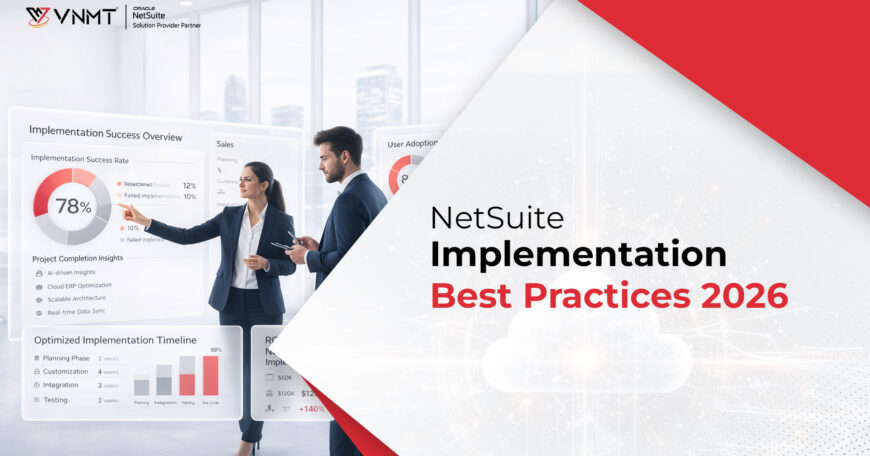

NetSuite implementation in 2026 looks very different from the past. ERP is no longer seen as a back-office system but as a strategic platform that drives automation, analytics, scalability, and faster decision-making. Organizations that treat NetSuite as a transformation initiative rather than just an IT project typically achieve faster ROI and stronger user adoption.
The following are the essential components of NetSuite Implementation Best Practices:
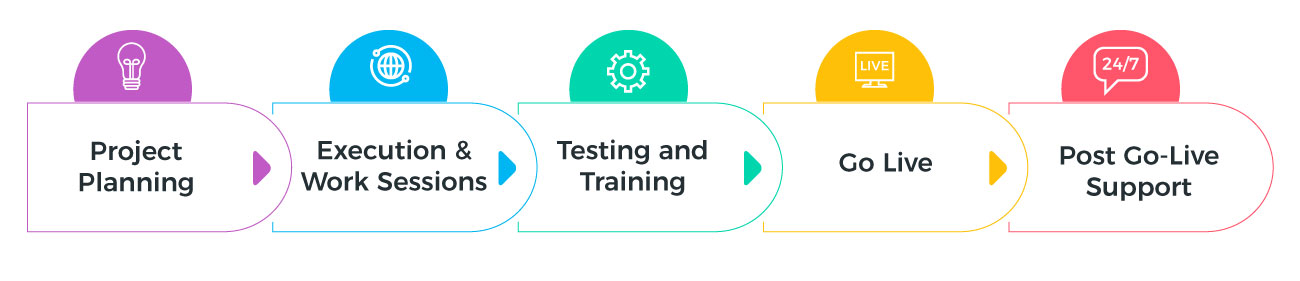
- Project planning – Using a process that has been clearly laid forth.
- Resource management: Ensure that your team’s implementation is flawless.
- Understanding your data requirements and migration plan is important for data migration.
- Testing – Conduct thorough testing prior to the go-live to guarantee appropriate operation and identify any faults that need to be fixed.
- Training – Setting users up for success through training.
- Support – Enough support to enable the development of a sound strategy and continuing support.
It is essential to comprehend the aforementioned components since they might independently impact the implementation process. In this article, we provide you with information on various best practices you may use when implementing NetSuite.
What sets 2026 apart is the maturity of cloud technology, the growing role of AI in ERP, and rising expectations for real-time visibility. Companies that still rely on outdated implementation approaches often face delays, low adoption, and post-go-live inefficiencies. This blog outlines practical best practices that help make the NetSuite implementation process more efficient, structured, and outcome-focused.
5 Important Ways To Ensure A Systematic NetSuite Implementation Process
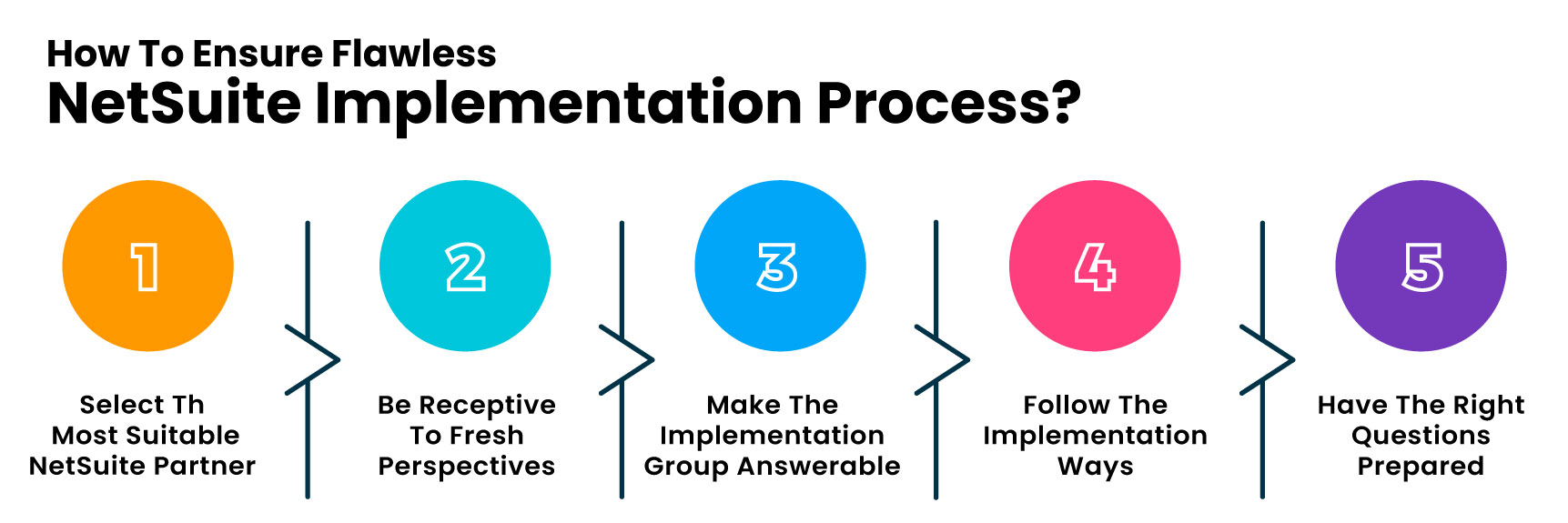
1. Select The Most Suitable NetSuite Partner
Work with a NetSuite partner who knows your company’s objectives, financial constraints, necessary go-live date, customization requirements, and available capacity. Verify the track record of your partner’s clients and verify if their Net Promoter Score is high. This will eventually demonstrate how knowledgeable and concerned your consultants are with a client’s business and industry demands. A great partner will smoothly facilitate the NetSuite setup process and ask you the relevant questions.
2. Be Receptive To Fresh Perspectives
Your consultants are highly skilled professionals who spend their days interacting directly with NetSuite software. Make sure you’re open-minded about various approaches to managing company operations since they know how it operates in its most efficient form. Using NetSuite’s technologies, what worked on your prior system could be a rudimentary method to achieve anything.
3. Make The Implementation Group Answerable
Make sure you follow up appropriately and stay available in case your partner has any questions. You wouldn’t just disappear as your contractors operated on your home if you were remodelling it, would you? Asking questions earlier in the process is preferable to doing so later. Put some serious money on your NetSuite deployment.
4. Follow The Implementation Ways
Getting a new system that can help your business function more smoothly is thrilling! Jumping ahead, though, will subsequently result in unforeseen problems. Have faith in your NetSuite consultants since they are knowledgeable about best practices.
5. Have The Right Questions Prepared
Pose some challenging queries to your buddy. What business functions fall inside and beyond the purview of this project, for instance? Will a system analysis be required? Any inquiries you have about the implementation won’t surprise a NetSuite implementation partner with expertise.
7 Steps Of Best NetSuite Implementation Practices
We should stick to the steps before beginning the NetSuite implementation methodology procedures.
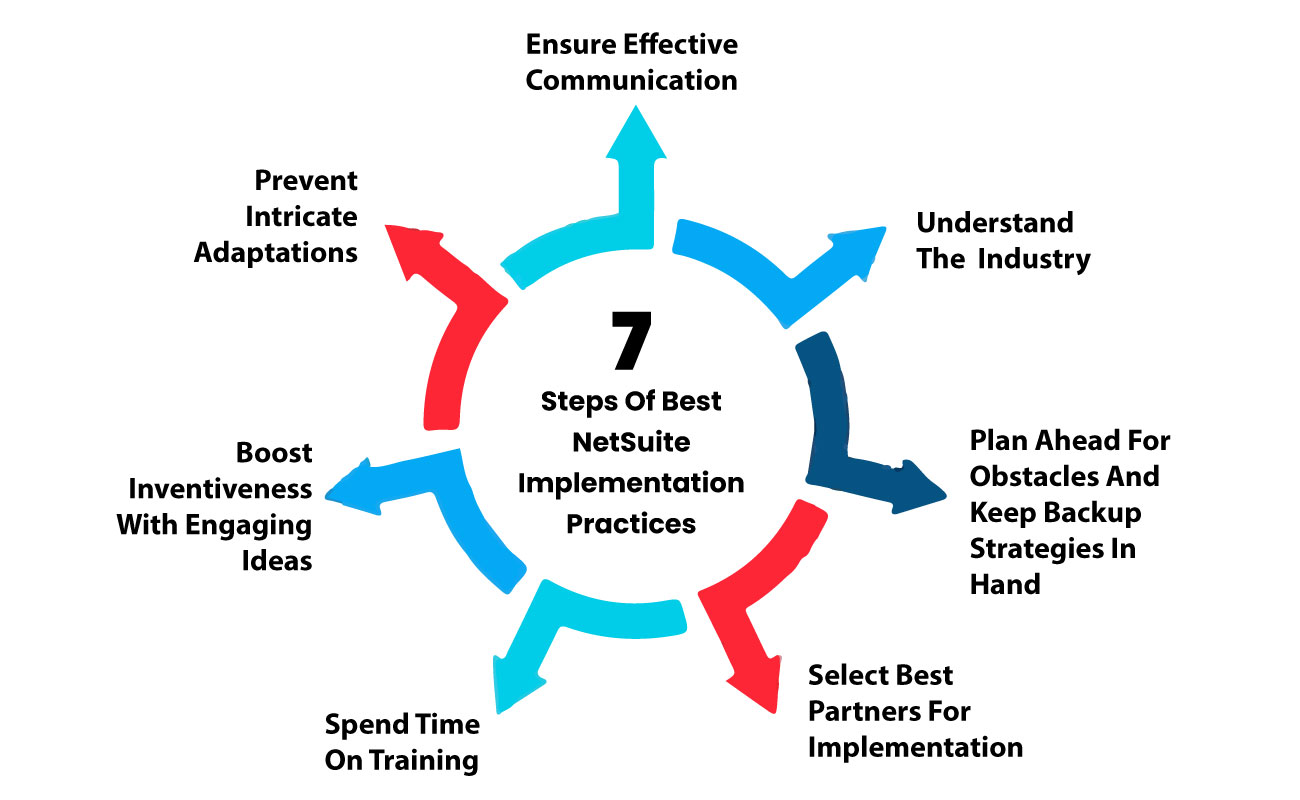
1. Understand The Industry
Prior to deployment, a better knowledge of company operations and procedures is required. We must produce thorough documentation outlining business procedures, highlighted functions, and other crucial details. It is essential since we intend to synchronize the entire company process with NetSuite, a more recent technology. Therefore, it is suggested that you fully comprehend the legacy business before transferring it to NetSuite.
Businesses must carefully review their implementation partners’ correct and comprehensive project plans. They must ensure that every area is addressed and prepared for action.
2. Plan Ahead For Obstacles And Keep Backup Strategies In Hand
The project management team should always have ERP strategies to deal with problems before they appear. Before the issues occur, they need to be anticipated and prepared with alternatives. We must be well-prepared for the difficulties and available choices. Thus, this may simplify things and guarantee business operations go without a hitch.
3. Select The Best Partners For Implementation
You must choose the finest implementation partners to ensure that the entire implementation process runs well. Once this is done, you won’t need to worry as much. Don’t forget to have questions ready for your NetSuite implementation partners in India. This might assist you in making sense of any process-related ambiguity. Their demonstrated knowledge and inquisitive spirit will guarantee the success of your implementation.
4. Spend Time On Training
Training is a crucial component of implementation. To operate the services and procedures in NetSuite, your staff members need to be properly trained. Although NetSuite may be a whole new platform for your staff, you should spend significant time teaching them to manage the company because effective utilization will determine your company’s success.
5. Boost Inventiveness With Engaging Ideas
Come up with creative ideas for effectively and correctly integrating NetSuite with your company. You need to think of better solutions to help you get a competitive edge by integrating your company with NetSuite.
6. Prevent Intricate Adaptations
Highly intricate customization may have poor effects. Customizations should only be added when absolutely necessary. The lack of operational efficiency and speed of NetSuite’s operation may have been caused by excessive customization. Customizations should only be made if NetSuite’s default features can’t accommodate the business process.
7. Ensure Effective Communication
We must make sure that the business representative overseeing the NetSuite installation guidelines and the implementation partners are in regular contact. The right communication ensures whether the system’s procedures are operating flawlessly or not. Additionally, from a business perspective, they must make sure they are receiving accurate information and are able to provide ideas in keeping a record of the implementation process.
However, you should know a few things before beginning a NetSuite deployment. You should link yourself with the direct or partner NetSuite implementation partners who provide you with a stress-free environment. Make sure that your implementation is delivered as promised, on budget, and in accordance with the following highlights. Keep in touch with the project team and those who are implementing it to ensure the project’s success. Finally, make sure you get assistance from your implementation partners once the project is completed.
Why NetSuite Implementations Are Different in 2026
In 2026, the deployment of ERP is facilitated by speed, intelligence, and scalability. Organizations demand that NetSuite provide insights from the early stages, automate, and be able to scale up or down depending upon the market. Key differences between 2026 implementation:
- Increased use of AI-based Automation and Analytics.
- Better coordination in a business system.
- Fast NetSuite implementation for scalability.
These changes require a more structured and strategic approach to implementing ERP solutions.
9 Key ERP Implementation Best Practices
These best practices cover every significant stage of ERP installation, from specifying needs to imparting knowledge and offering assistance. They may assist in ensuring that your ERP implementation strategies satisfy your company goals, reducing the chance of cost and time overruns, and empowering staff to utilize the system proficiently as you complete your implementation checklist.
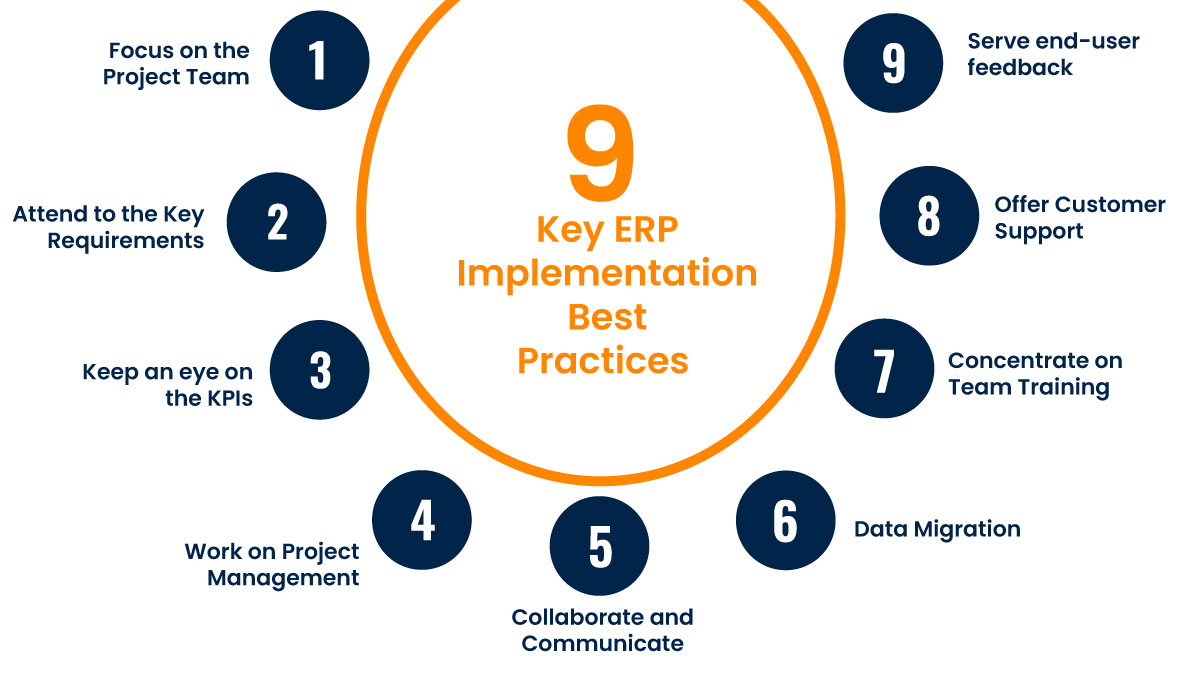
1. Connect ERP Implementation to Business Strategy
The key to successful ERP implementation is alignment. Prior to configuration, it has to be determined what an organization wishes to accomplish using NetSuite. These consist of:
- Identifying core business challenges.
- Defining clear and measurable KPIs.
- Aligning expectations across leadership and stakeholders.
Having clear objectives ensures the NetSuite implementation strategy is not only result-oriented but also does not involve unnecessary complexity.
2. Build a Structured NetSuite Implementation Plan
An effective plan for implementing NetSuite is essential for managing scope, timing, and risk. In 2026, it’s desirable to have phased implementations to sync with progress. A good plan usually includes:
- Requirement validation and solution design.
- System setup & testing.
- Data Migration and Integrations.
- User training and readiness.
- Controlled NetSuite go-live.
3. Standardize Business Processes Before Customization
One of the key best practices in ERP implementation is maintaining a strong focus on standardization. NetSuite provides a wide range of industry-standard business processes that support smoother deployments and long-term system stability. Organizations should-
- Use standard NetSuite processes wherever possible.
- Only customize when there is clear and measurable business value.
- Avoid changes that limit scalability or complicate future upgrades.
- Over-customization is one of the biggest reasons ERP upgrades fail or become unnecessarily expensive.
This ensures that the system is stable and ready for optimization.
4. Apply NetSuite Data Migration Best Practices
Data migration is critical to ERP success. Accurate, well-preparedwell prepared data ensures reliable reporting and business visibility once NetSuite goes live. The best practices for NetSuite data migration are as follows:
- The analysis involves auditing and cleansing the existing data.
- Eliminating Duplicates and Obsolete Entries
- Ascertaining ownership regarding data
- The process of multiple test migrations
Validated or cleaned data ensures accurate analysis for automated or AI analysis.
5. Use AI in ERP Implementation Strategically
AI in ERP implementation has evolved from a future-focusedfuture focused idea into a practical driver of present-daypresent day operations. These AI-driven efficiencies support faster decision-making, reduce manual effort, and help teams identify issues before they escalate. At the same time, AI should support decision-making and operational efficiency, but with strong governance. Practical examples of AI usage include:
- Predictive financial forecasting
- Intelligent Anomaly Detection
- Automated Approvals & Intelligent Workflows
- Insight-driven reporting
Embed a culture of AI early to ensure value realization beyond mere automation of systems in businesses.
6. Plan System Integrations During ERP Deployment
Modern ERP systems are part of the extended ecosystem. The implementation of 2026 NetSuite also has to take into consideration integrations with CRM, eCommerce, payroll, and analytics platforms. Best practices include:
- Defining integration requirements early
- Ensuring data synchronization consistently
- Extensive testing of the integrations before NetSuite goes live
Well-planned integrations lessen manual efforts and increase data reliability across systems.
7. Focus on User Adoption and Change Management
Success in an ERP system is not driven by technology alone. User adoption is also a critical component of ERP implementation. Effective change management involves:
- Training Based on Roles and Responsibilities
- Participation by important users during testing stages
- Effective communication concerning procedural modifications
Adopting organizations tend to experience smoother NetSuite installations and quicker returns on investment.
8. Test Thoroughly Before NetSuite Go-Live
The process of testing verifies whether everything from the system functionality to real-world business scenarios is working correctly. The last phase to complete before going live results in complications if it is done hastily. Testing should encompass:
- End-to-end workflows
- Data accuracy and reporting
- Integration performance
- User acceptance scenarios
These structured NetSuite go-live recommendations help reduce risk and build confidence throughout the go-live process.
9. Optimize and Scale After ERP Implementation
The deployment of the ERP system is not complete after a NetSuite go-live. Optimization ensures that the system meets the growing needs of the business. Best practices for the post-deployment phase-
- Tracking KPIs and system usage
- Working with workflows based on performance intelligence
- Enabling further NetSuite functionalities if needed
Cloud ERP system implementation trends in 2026 also support this, as scalability is a key requirement in such processes.
NetSuite Implementation Trends in 2026
NetSuite benefits from improved forecasting, approvals, and exception handling capabilities in the businesses.
- Real-time dashboards and analytics enable fast, data-driven decision-making.
- NetSuite supports business growth without disrupting the existing system flow.
- Today, ERP systems are continuously optimized, whereas earlier they were viewed as one-time projects with limited scope for change.
Who Will Deploy NetSuite For You?
- Implementation Immediately
If you purchase the software directly from NetSuite, their team will probably manage your implementation process. In other circumstances, they could enlist a partner of their choosing to carry out the implementation on their behalf. Since they are the program publisher, you won’t experience product understanding or technical proficiency problems.
However, there are many more factors to consider while installing ERP software. Your implementation staff should be well-versed in your industry as a whole, not simply industries similar to yours. Since they have a more directive approach, you won’t get the same depth from the NetSuite direct staff as you would from a NetSuite installation partner.
- Partner-based Execution
Developing a stronger relationship with a NetSuite implementation partner will benefit your company over the long run. As they thoroughly analyze every aspect of your company to develop a solution that perfectly matches it, your partner becomes an extension of your team. Additionally, NetSuite partners have a substantial edge over the direct model due to their equivalent technological skill levels.
Keep in mind that this is the central system that controls your company. It’s crucial to have a partner who cares about your achievement. To establish a good match, you should choose your ERP partner with the same care as you do the program.
- Self-implementation
However, it is possible to implement NetSuite on your own; we do not advise it. Your project will fail unless you have committed in-house personnel with considerable NetSuite knowledge. Although there are several difficulties with self-implementation, small to mid-size businesses typically lack the money, time, or knowledge necessary to properly deploy ERP on their own.

Ensure a Successful ERP Deployment in 2026
To ensure a successful NetSuite ERP implementation in 2026, organizations should follow proven best practices and build a strategy with clear intent and alignment to business goals. As you evaluate your approach, it can help to learn from implementation specialists who work closely with businesses on real ERP challenges, from system setup to process optimization.
VNMT Solutions shares practical perspectives and guidance drawn from hands-on NetSuite implementation and improvement projects, which can support more informed planning and decision making. Applying structured best practices and expert-led insights allows businesses to maximize their NetSuite investment and move forward with greater clarity and confidence.