
Technology upgrades require more than financial investment; they also require time and resources to implement, adapt, and deliver measurable business value. The major consideration when implementing ERP is how much time it will require. The time required to implement ERP is not the same for all businesses. For NetSuite, the typical implementation timeframe can vary from three to six months, depending on the size and complexity of the business and its needs. Proper implementation requires proper execution. There is nothing worse than making costly mistakes after implementation because of a lack of preparation, bad data, inadequate training, and insufficient testing.
According to Oracle NetSuite, setting clear implementation goals and expectations at the beginning of a project supports reliable delivery and helps keep implementations on schedule and within budget.
What Is a NetSuite Implementation Timeline?
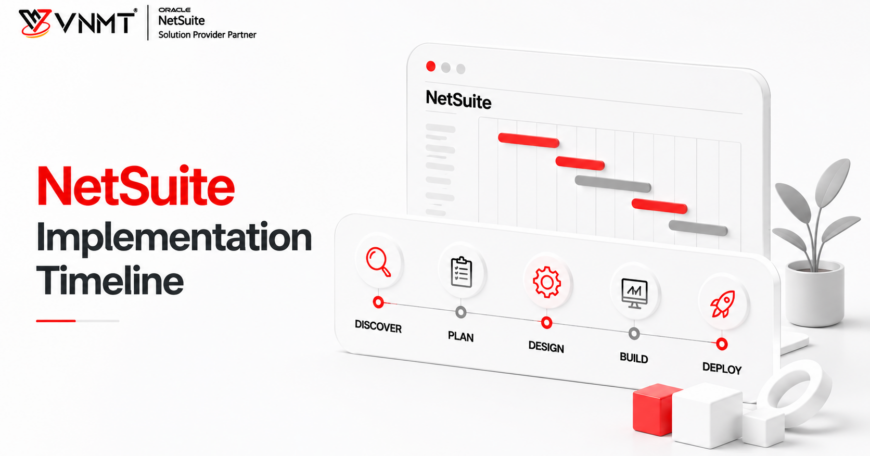
A NetSuite Implementation Timeline outlines the key stages of an implementation, from initial planning and preparation to deployment and post-go-live support. It helps businesses define responsibilities, set realistic timelines, and manage the project through clear, actionable phases rather than treating implementation as a single event.
Typical NetSuite Implementation Timeline
Most organizations implement their projects in the range of three to six months. The overall implementation timeline depends on several factors, including your business processes, system complexity, customization requirements, data readiness, existing software, and the availability of your internal team.
Discovery & Planning (2 to 3 Weeks)
All successful ERP implementations start with understanding the business. During this stage, implementation consultants collaborate with all parties involved to understand existing processes, business goals, reporting needs, and pain points.
At this point, the project scope, timeline, responsibility allocation, and success criteria are established. This stage lays down the foundation of the whole project. Companies that spend sufficient time in planning typically encounter fewer problems during future implementation stages.
Solution Design (2 to 4 Weeks)
Once the project scope is agreed upon, the implementation team starts designing how NetSuite will be used in business operations. Financial processes, inventories, procurement, CRM, approvals, dashboards, reporting, user permissions, and other processes are designed based on the needs of the company. If third-party applications need to connect with NetSuite, the integration strategy is planned during this phase. A properly designed solution will minimize the need for unnecessary customization.
Configuration and Customization (4 to 8 Weeks)
NetSuite consultants configure company settings, accounting and tax preferences, subsidiaries, workflows, forms, saved searches, and dashboards. Required customizations can be developed using SuiteFlow or SuiteScript. Businesses should customize only when necessary to simplify future upgrades and maintenance.
Data Migration (2 to 4 Weeks)
Data migration can be one of the most challenging ERP implementation stages. Businesses should clean, validate, and test customer, vendor, inventory, accounting, and transaction data before importing it into NetSuite. Multiple test migrations can help identify errors, reduce delays, and improve data accuracy.
Testing and User Training (2 to 3 Weeks)
Every business process has to be properly tested before going live. The implementation team checks all financial transactions, approvals, reports, integrations, moves of inventory, and workflow automation.
Simultaneously, the business users conduct User Acceptance Testing in order to make sure that NetSuite covers all requirements of their operations. User training is no less important a task. Informed users are more comfortable and adopt changes quicker.
Go Live and Hypercare (1 to 2 Weeks)
Go-live will only be the starting point for your work with NetSuite, not the end of the project.
After going live, the consultants will check the transactions, address all issues, and provide support to the users. The period of such support is called Hypercare and serves to stabilize operations and adjust employees to the new ERP system.
According to Oracle, its SuiteSuccess approach is focused on phased implementation and further optimization of the implemented system. These phases may overlap depending on the project structure, so the total implementation timeline should not be calculated simply by adding every phase together.
What Can Affect Your NetSuite Implementation Timeline?
There are various aspects that will determine the speed of your implementation.
- Your implementation process will be longer if you have operations in multiple places, subsidiaries, or even multiple countries.
- The more complex your workflows, integrations, and reporting needs are, the longer your implementation is likely to take.
- If you have poor-quality legacy data, more time will be needed to clean it up.
- Late approvals from stakeholders will always lead to delays.
- Not enough employee availability will also cause delays.
What Can Speed Up a NetSuite Implementation?
By adopting a properly thought-out strategy, companies can save time, use their resources more effectively, and speed up their journey through the NetSuite implementation process:
- Scope out the project thoroughly from the very beginning.
- Validate data before starting migration.
- Engage key stakeholders in the process.
- Use built-in functionalities of the system where appropriate.
- Work with a competent implementation team.
- Test configurations and workflows at the initial stage of the project.
- Provide training to end-users before going live.
- Plan for integration early on.
Common Reasons NetSuite Implementations Get Delayed
Even well-thought-out projects can run into problems if typical problems are not resolved early enough.
- Modifying the requirements of a project post-implementation raises its cost and timeline.
- Lack of documentation causes problems during configuration and testing processes.
- Problems with the preparation of data usually have repercussions on several implementation stages.
- The lack of proper user training causes low project adoption rates and more support requests.
- A poor choice of a NetSuite implementation partner can result in unnecessary project risks.
Standard vs. Complex NetSuite Implementation
The complexity and the extent of a NetSuite project can greatly impact the project’s total timeline. A typical implementation would employ basic NetSuite functionality with little modification, while an advanced implementation would demand extensive configuration, integration, customization, and data manipulation.
Standard NetSuite Implementation
A typical implementation can comprise:
- Core Financial Management
- Basic Inventory Management
- Standardized processes and workflows
- Fewer number of integrations
- Less customization
Advanced NetSuite Implementation
A complex implementation may involve:
- Multinational companies with many subsidiaries
- Operations spanning many countries
- Advanced Revenue Management
- Advanced Inventory and Fulfillment processes
- Several eCommerce sales channels
- Several third-party integrations
- Development of Custom SuiteScript
- Advanced Reporting and Analytics
- Data migration from several legacy systems
The greater the complexity of the business model, the more time that could be required for solution development, integrations, data migration, testing, and training.
NetSuite Go Live Checklist
Make sure that you have covered all the necessary actions prior to implementing the ERP system.
1. Reconcile migrated data, review open transactions, and verify financial opening balances against the source records.
2. Complete UAT for critical workflows, reports, forms, integrations, and business processes.
3. Validate integrations and confirm that user roles and permissions provide appropriate system access.
4. Complete end-user training and provide relevant process documentation before launch.
5. Finalize the cutover plan, including final migration, system freeze, responsibilities, rollback procedures, and business continuity measures.
6. Establish a support escalation process and monitor system performance, integrations, transactions, and critical processes after go-live.
What Happens After NetSuite Go-Live?
Go-live does not signal the end of the implementation process. Post go-live will be devoted to stabilizing the system, fixing issues, and enhancing usage of NetSuite by the business.
First few days: Transaction monitoring, critical issue fixing, integrations check, and quick support for users.
First few weeks- Workflow review, fixing reporting deficiencies, process optimization, and taking into account user feedback.
Post-stabilization: System optimization, extra automation, module implementation, and further business process optimization.

Why Choose VNMT Solutions for NetSuite Implementation?
A successful ERP implementation requires more than technical expertise; it also depends on proper planning and industry experience. With NetSuite implementation services from VNMT Solutions, businesses receive support across configuration, customization, data migration, integrations, training, and post-implementation support. Regardless of whether you are implementing NetSuite for the first time or looking to upgrade your existing one, we have the right people to implement the project in a manner that will minimize risks and ensure a quicker realization of the benefits. Get ready to start on your NetSuite journey today. Reach out to us now.