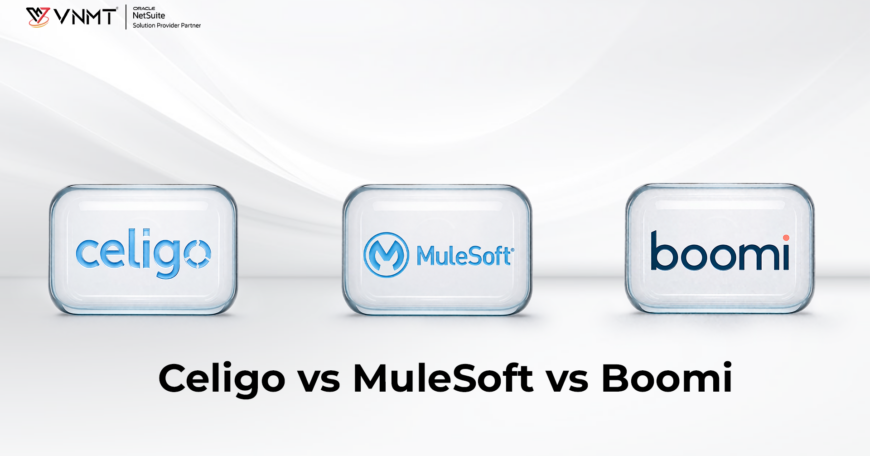

Disconnected systems lead to delays, data inconsistencies, and reporting gaps that hinder business growth. For companies using NetSuite as their core operational platform, the focus shifts to solutions that deliver automation, accuracy, and visibility in one unified approach. This is where comparisons like Celigo vs MuleSoft and Celigo vs Boomi become relevant within the broader context of scaling business operations.
This blog helps you compare MuleSoft and Boomi, highlighting their key differences so you can choose the right integration solution for your business.
Why the Right iPaaS Makes a Real Difference
Selecting an integration platform is not an exercise in technical selection alone. It has significant implications for the efficiency of your team’s work processes and the accuracy of the data you use. The benefits of an effective NetSuite integration platform include the following-
- Data is kept in sync across systems in near real time.
- Reduces the need for manual work and minimizes operational delays.
- Data accuracy is improved for better decision-making.
- Supports growing businesses without the need for rebuilding the integration.
With these benefits in mind, the advantages of each platform are easier to see.
How Each Platform Approaches Integration
Before we dive into the features, let’s briefly examine how each of these integration tools approaches integration.
Celigo
Celigo is built with usability at its core, emphasizing low-code automation, pre-built connectors, and rapid deployment. It enables both IT and business teams to collaborate efficiently, making integrations faster and more accessible.
MuleSoft
MuleSoft uses the API led connectivity approach, focusing on governance, reuse, and enterprise-class management. It is often used by companies dealing with large-scale integration environments.
Boomi
Boomi claims to offer a highly flexible integration platform, capable of connecting a wide range of cloud, on-premises, and legacy systems, often in environments where there are many applications to integrate.
Also Read: Celigo vs Dell Boomi
Celigo vs MuleSoft vs Boomi: What Sets Them Apart
Understanding these differences enables businesses to select the platform that best aligns with their requirements and existing processes.
Implementation and Time to Value
Celigo allows for faster implementation because it has a user-friendly interface and is ready to use with its connectors.
MuleSoft has a more structured setup process. Its API-driven architecture allows for more control, but it also has a more time-consuming setup process.
Boomi is somewhere in the middle. It has flexibility, but it might still need a technical setup, depending on the complexity.
Scalability and Governance
As the need for integration continues to grow, the need for governance also grows.
MuleSoft excels in environments that require very high levels of API governance, versioning, and management across many systems.
Celigo excels at scalability for the majority of mid-market and enterprise environments while keeping the workflows easy to use and simple.
Boomi excels at scalable integrations, especially for hybrid environments that require different types of systems to coexist.
Usability and Day-to-Day Management
The usability of the platform is very important for the day-to-day management of the platform.
The platform offered by Celigo has a monitoring feature, which makes it easier to handle errors. The platform also provides a better understanding of the workflow.
The platform offered by Boomi has powerful features. However, the management of the platform requires a lot of hands-on management.
The platform offered by MuleSoft has powerful features. However, the platform requires a team to manage the workflow.
Flexibility and Integration Coverage
Every organization has varying integration needs, and flexibility is a key consideration.
Boomi is known for its ability to integrate hybrid environments and transformations.
Celigo is best suited for organizations looking to integrate with NetSuite, as it can efficiently manage processes like order management and financial data sync.
MuleSoft is best suited for organizations looking for flexibility in integration through APIs.
Read About: Top Celigo Use Cases Across Industries
Key Factors to Evaluate Before Choosing
The priority of integration varies for each organization. Hence, the best platform for the organization to choose depends on the alignment of the objectives. The factors to consider before the evaluation of the best platform for the organization to choose are as follows:
Integration Complexity and Use Cases
The first factor to consider is the number of systems and the complexity of workflows. Companies with simple data syncs and straightforward processes may opt for a low-code platform, while those needing complex orchestration require a solution that supports advanced integrations.
Internal Technical Expertise
The people who manage the integration platform determine the success of the integration platform.
For example, a company with a large developer base might consider a platform that requires a high degree of technical expertise. However, a company with a lean IT staff might consider a platform that provides ease of use.
Scalability and Future Growth
Think not only about what you need to integrate now, but also about what you will need in the next three to five years. The platform scales to meet increasing transactions, new applications, and changing business processes without having to redesign integrations from the ground up.
Governance and Compliance Requirements
If you are in a highly regulated industry or a global business, consider how well the platform can support your security policies, access, versioning, and audit requirements.
Monitoring, Error Handling, and Support
The success of the integration process does not only depend on the deployment, but also on the management. Consider the ease with which the platform allows you to monitor the workflows, detect errors, and manage these errors.
Also Read About: How Celigo iPaaS Simplifies Cloud Integration for Growing Businesses

Choose the Integration Platform That Supports Your Growth
A well-planned integration strategy transforms your business by streamlining processes, improving transparency, and freeing employees to focus on innovation instead of routine tasks. With the right tools and expert guidance, integrations become a foundation for faster decision-making, smoother operations, and scalability that addresses both current and future challenges.
At VNMT Solutions, we help businesses leverage NetSuite integrations and digital transformation strategies to drive measurable results. Follow VNMT Solutions on LinkedIn for expert insights, practical tips, and strategies to optimize your systems and stay ahead in a rapidly evolving business environment.