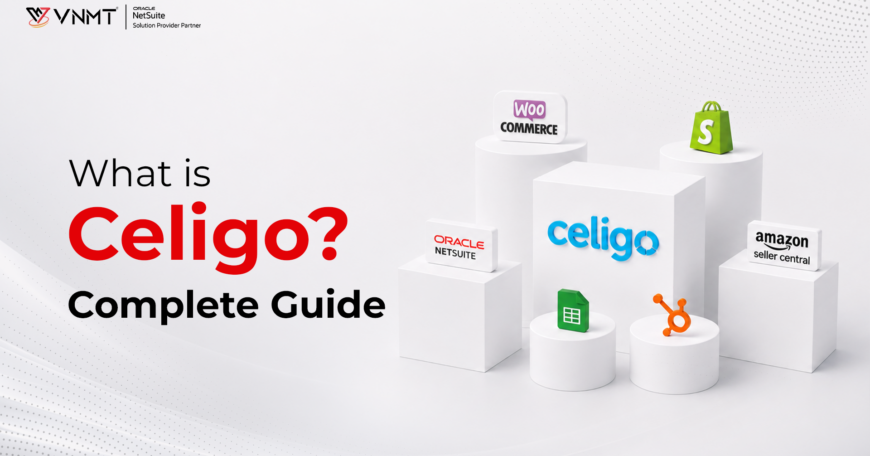

Celigo is a cloud-based iPaaS platform that helps businesses connect applications like NetSuite, Shopify, Salesforce, Amazon, and HubSpot. It automates workflows, synchronizes business data across systems, reduces manual processes, and improves operational efficiency through faster and more scalable integrations between business applications.
Modern businesses use multiple applications to manage daily operations, sales, finance, eCommerce activities, customer support, and reporting. Though individual applications increase efficiency, disconnected applications can create business silos, duplicating data and processes, delaying reporting, and adding unnecessary manual processes. This is where integration platforms such as Celigo become so valuable for modern businesses.
Do you know what Celigo is, how it works, and why many businesses in the USA, Australia, and other international markets are embracing iPaaS? This guide gives an explanation in straightforward business terms. Celigo has transformed itself into an AI-driven integration platform used by organizations to streamline their operations using NetSuite, Shopify, and other enterprise software.
What Is Celigo?
It is a cloud integration platform designed for streamlining the process of connecting various applications, automating workflows, and moving data. Celigo is known for its ability to integrate ERP, CRM, e-commerce, financial, and marketplace applications in an easy manner. Typically, companies connect applications like NetSuite, Shopify, Salesforce, Amazon, HubSpot, Microsoft Dynamics, and others through the services provided by Celigo.
Integrator.io is one of the major components of the Celigo integration platform, which is a low-code platform that enables organizations to manage their workflows more effectively and efficiently. In essence, Celigo can be viewed as the bridge between various business applications. In place of having employees manually move information from one system to another, Celigo uses APIs, workflow logic, triggers, and real-time synchronization.
During its development, Celigo transformed into much more than just a tool for integrating applications. Currently, the platform provides advanced workflow automation, AI-driven workloads, monitoring features, process automation scalability, and integration governance. It becomes especially useful for managing automation and integration when dealing with several sales channels and different systems within a company.
A Brief History of Celigo
Celigo was started in 2006. With a small team of experts beginning their journey from a garage, Celigo has now reached more than 100 employees. The client base counts more than 800, and Celigo has six offices across the world.
- San Mateo, California – World Headquarters
- Roseville
- Indianapolis
- Amsterdam
- Hyderabad
- Manila
The name Celigo was coined using two words: Central and Ligo, which means to bind. Of course, for its title and clarity of mission, it has gained many awards in its journey. The product was launched in 2011, and from then on, there has been no stopping the upgrades. Every business process is automated with innovative techniques.
The best part of the mission is to offer automation solutions to businesses that do not know IT. That means the tool is highly user-friendly for people without coding experience, too. The prebuilt packages were made from the beginning, and there is no deviation from the principle of developing the application. It is one of the reasons why companies seek Celigo Login to integrate their business functionalities.
How Does Celigo Function?
It is common for many organizations to think about integration as a complex project, which requires substantial software development efforts. There are numerous reasons why Celigo became so popular, but one of them is its approach to the automation of integration processes through preconfigured connectors and workflow templates. A standard Celigo workflow consists of several steps.
Data Source
The process starts with identifying a source system like Shopify, Salesforce, Amazon, or any other business application.
Integration Logic
Celigo processes information according to the logic specified in a workflow. It can include data mapping, filtering, validation, transformation, or applying business rules.
API Communication
In order to provide secure communication, information is transferred from one system to another via APIs.
Destination System
Processed data is delivered to the destination system, such as NetSuite, CRM, and logistics solutions.
So when an order is created on an e-commerce website, for instance, Celigo can automatically perform such actions as-
- Creating the sales order in NetSuite
- Updating inventory quantities
- Starting fulfillment flows
- Customer data synchronization
- Generating invoices
- Updating shipping statuses
This way, all the processes can be automated instead of being performed manually.
What Is Celigo Integration?
Celigo Software is a platform that connects various automation tools required for every department to function in synergy. iPaaS helps in standardizing the business processes by integrating the tools needed for the organization. The devices shall start transacting according to the functionality, making it an independent platform for all the necessary tools.
Celigo, as a tool, helps in the below-mentioned aspects
1. Secure and Prompt Data Delivery
2. Incredible Error Handling
3. Exclusive Connectors for different applications
4. Data Governance is at its best
5. Entire Lifecycle management is controlled.
6. One can make Deep Customization of tools according to the requirements.
Key Features of the Celigo Integration Platform
Increased adoption of Celigo is attributed to its capability of not only improving operational efficiency but also offering scalability for automations. While Celigo is considered technical in nature, most of its benefits directly influence day-to-day business operations.
Low-Code Integration Platform
The Celigo integrator.io software enables organizations to construct workflows through visual interfaces rather than coding from scratch. This simplifies implementation and streamlines the process of integrating the software.
Predefined Integration Templates
Integration templates for frequently used applications such as NetSuite, Shopify, Salesforce, Amazon, and other business apps are offered by Celigo. This saves time in implementation due to predefined configurations.
Real-Time Data Synchronization
Data can be synchronized between applications in near real-time, providing better visibility within business operations. It minimizes delays in reporting due to disconnected business applications.
Workflow Automation
In addition to enabling easy integrations, Celigo also provides automation features such as approving and notifying users, managing orders, customers, fulfilling, and financial automation.
Error Detection and Management
Inconsistencies within the integration process can affect processes if they are not detected early enough. Celigo is equipped with tools for detecting and managing such inconsistencies to ensure workflow reliability.
Scalability Architecture
The needs for integration increase and become more sophisticated as the company grows. Celigo caters to large-scale integration requirements of companies with multiple business applications.
Why Businesses Choose Celigo
Businesses use multiple applications to manage sales, finance, inventory, customer relationships, reporting, and operations. When these systems are disconnected, companies often face manual work, reporting delays, duplicate data, and operational inefficiencies. Celigo helps solve these challenges through integration and automation.
Centralized Integration Platform
- Connects ERP, CRM, eCommerce, finance, and operational systems from one platform.
- Helps businesses manage data movement more efficiently across applications.
Reduces Manual Work
- Automates repetitive processes like order management, invoicing, inventory updates, and customer synchronization.
- Minimizes manual data entry and reduces operational errors.
Faster Integration with Prebuilt Connectors
- Provides ready-to-use connectors for NetSuite, Shopify, Salesforce, Amazon, HubSpot, and other platforms.
- Reduces development time compared to custom integrations.
Better Visibility Across Departments
- Keeps finance, sales, operations, and customer service teams aligned with real-time information.
- Improves reporting accuracy and decision-making.
Scalable for Growing Businesses
- Supports additional applications, sales channels, warehouses, and business processes as operations expand.
- Helps businesses scale integrations without rebuilding workflows repeatedly.
Improved Monitoring and Control
- Offers centralized workflow monitoring and exception management.
- Helps businesses identify synchronization issues quickly and maintain smoother operations.
For businesses focused on automation, efficiency, and long-term scalability, Celigo provides a flexible and reliable integration solution that supports connected business operations.
Popular Celigo Integration Use Cases
Another key benefit provided by Celigo is its versatility across industries and business types, as it provides functionalities such as e-commerce processes, accounting automation, CRM synchronization, marketplaces, and workflow automation for enterprises.
Celigo NetSuite Integration
The Celigo NetSuite integration is one of the most commonly used Celigo functionalities.
Companies that use NetSuite typically integrate their e-commerce platforms, marketplaces, CRM software, and shipping software to consolidate operations and provide financial transparency. In the case of an e-commerce company that sells goods on Shopify and Amazon platforms, it can automate synchronization of the following information:
- Orders
- Inventory
- Clients
- Refunds
- Fulfillments
- Finance information
NetSuite integrations are highly beneficial for growing companies running multi-channel e-commerce operations.
Celigo Shopify Integration
Many Shopify sellers often face challenges related to inventory sync issues, delays in order handling, and disconnected financial reports. Celigo automates the transfer of data from Shopify to back-end applications like NetSuite, ERP, and CRM systems. This allows for efficient handling of-
- Order management
- Synchronization of products
- Taxes calculation
- Updating customer information
- Shipping processes
- Return management
The result is improved operational efficiency and a more seamless customer experience.
Celigo HubSpot Integration
Businesses using HubSpot alongside NetSuite and other business applications often struggle with disconnected customer and sales data. Celigo HubSpot integration helps create smoother workflows by automating data synchronization between systems.
- Connects HubSpot with NetSuite and other operational platforms for better data flow.
- Automates customer records, leads, contacts, invoices, and sales information updates.
- Reduces manual data entry and minimizes synchronization errors.
- Helps sales, marketing, and finance teams access updated real-time information.
- Improves reporting visibility and workflow efficiency across departments.
- Supports scalable CRM and ERP operations as business processes grow.
Celigo Salesforce and CRM Integration
With Celigo Salesforce & CRM Integration, you can integrate customer relationship management applications, which are essential in marketing, sales, and support activities. However, disconnected CRMs often result in a lack of visibility across departments.
CRM integration features enable synchronization of customers’ information, sales opportunities, invoices, and other updates. For instance, sales opportunities from Salesforce can be converted into sales orders in an ERP system. Similarly, customer updates can be synchronized across other applications.
Celigo Amazon Integration
For sellers who use the Amazon platform for their marketplace needs, they have to deal with heavy orders and frequent changes in their inventory. With Celigo, marketplace operations can be automated through the integration of Amazon with ERP and order fulfillment. Automation can be done for:
- Stock inventory
- Order processing
- Shipping confirmation
- Returns handling
- Accounting reconciliation
This reduces operational bottlenecks and helps sellers maintain accurate inventory availability across channels.
How Different Industries Use Celigo for Integration and Automation
Businesses across multiple industries use Celigo to simplify integrations, automate workflows, and improve operational visibility between their business systems. As companies manage growing volumes of data across ERP, CRM, e-commerce, finance, and inventory platforms, integration automation becomes essential for maintaining efficiency and accuracy.
Retail and E-Commerce
Retail and e-commerce businesses use Celigo to connect platforms such as NetSuite, Shopify, Amazon, marketplaces, payment systems, and shipping applications. Automation helps synchronize orders, inventory, customer information, returns, and fulfillment processes in real time. This reduces manual work while improving customer experience and order accuracy.
Manufacturing
Manufacturing companies often manage complex supply chains, procurement operations, production planning, and inventory management across multiple systems. Celigo helps manufacturers integrate ERP systems with warehouse, logistics, procurement, and supplier platforms to improve operational coordination and reporting visibility.
Wholesale Distribution
Wholesale distributors use Celigo to automate inventory synchronization, purchase orders, invoice processing, warehouse updates, and customer order management. Integration between ERP systems, distributors, suppliers, and sales channels helps businesses reduce delays, improve stock visibility, and streamline fulfillment operations.
SaaS and Technology Companies
SaaS businesses frequently rely on multiple cloud-based applications for finance, customer management, subscriptions, billing, and support operations. Celigo helps integrate CRM platforms, billing systems, ERP software, and reporting tools to create centralized data visibility and improve workflow efficiency across departments.
Healthcare and Life Sciences
Healthcare organizations and life sciences companies use integrations to manage financial systems, procurement, inventory tracking, patient-related workflows, and reporting processes. Celigo helps automate secure data movement between applications while supporting operational accuracy and process standardization.
As businesses continue expanding their digital operations, Celigo provides industry-specific integration flexibility that supports automation, scalability, and connected business processes across different operational environments.
Business Benefits of Using Celigo
As businesses evolve into more digital entities, the complexity of integration issues will continue to increase. In addition to technical benefits, Celigo iPaaS brings some operational advantages.
Decreased Manual Effort
Manually entering data is not only laborious but also leads to mistakes. Celigo automates repetitive work and frees up time for more critical operations.
Increased Operational Transparency
The integration of various systems allows for greater transparency, especially in finance, inventory, sales, and customer operations, since all data exchange occurs in real time.
Increased Speed of Operations
Integration and synchronization of data provide leaders with up-to-date information that can help in faster decision-making.
Greater Focus on Customer Satisfaction
Systems that do not integrate may cause some disruptions and delays in processing orders, providing assistance, or communicating with customers. This may be prevented by using automated systems.
Ease of Integration
Adding new processes, applications, or channels will mean adding more integrations. Celigo supports scalability and does not require new technologies and hardware resources.
Simplification of Integration Management
Celigo reduces the complexities of integrating systems thanks to its low-code approach and pre-built connectors.
Why Choose Celigo Instead of Custom Integrations?
Many businesses start with custom API integrations to connect their ERP, CRM, e-commerce, and operational platforms. Although custom integrations offer flexibility initially, they often become difficult to manage as business operations grow and workflows become more complex.
Custom Integrations Often Lead to Higher Maintenance
Custom-coded integrations require ongoing updates, troubleshooting, and testing whenever applications change their APIs or processes. Businesses usually depend heavily on developers to maintain workflows, fix synchronization issues, and manage system compatibility over time.
Developer Dependency Slows Operational Flexibility
Even small workflow changes may require technical involvement when using custom integrations. This dependency can slow down business operations, increase support costs, and make scaling integrations across multiple systems more challenging.
Celigo Simplifies Integration Management
Celigo provides a modern iPaaS solution with prebuilt connectors for platforms like NetSuite, Shopify, Salesforce, Amazon, and other business applications. Businesses can implement integrations faster without building workflows entirely from scratch.
Prebuilt Connectors Improve Efficiency
Ready-to-use integration templates reduce implementation time and minimize configuration complexity. This allows businesses to automate processes quickly while maintaining accurate data synchronization between systems.
Centralized Monitoring and Better Visibility
Celigo offers centralized monitoring tools that help businesses track workflows, manage exceptions, and monitor integration performance from a single platform. This improves operational visibility and reduces manual troubleshooting efforts.
Built for Scalability and Governance
As businesses expand operations, Celigo supports scalable integrations across multiple applications, sales channels, and departments. Workflow governance, automation controls, and standardized integration processes help maintain consistency, security, and long-term operational efficiency.
For businesses looking to reduce maintenance complexity and improve scalability, Celigo provides a more flexible and future-ready alternative compared to traditional custom integrations.
What is iPaaS and Why Do Businesses Use It?
Before we discuss Celigo, we need to understand the meaning of iPaaS.
iPaaS stands for Integration Platform as a Service. This term refers to a cloud-based platform used to integrate various applications, automate work processes, and facilitate the synchronization of data without heavy reliance on manual efforts.
Modern businesses use multiple platforms simultaneously. For instance, a company can be using NetSuite for its ERP processes, Salesforce for its CRM functions, Shopify for e-commerce, Amazon for its marketplace transactions, and some third-party logistics solutions to manage the shipping of goods. Without the integration process, people would have to do things manually, thus causing delays and mistakes. The iPaaS solution addresses this issue through the creation of automated workflows.
For instance, when a client orders in Shopify, the data can be transferred seamlessly to NetSuite, where the accounting, stock management, and order processing can happen. On the other hand, the data related to the client can be synced in the CRM application, which is useful for the sales and support team. Businesses need iPaaS platforms since they-
- Cut down manual effort
- Increase operational efficiency
- Provide real-time reports
- Prevent data duplication
- Promote business scalability
- Enhance customer experience
- Bridge the gap between cloud and on-premises software
With cloud apps being used more extensively by organizations in 2026, iPaaS platforms have gained tremendous importance.
iPaaS Trends and the Future of Automation
As organizations embrace AI-powered operations and the adoption of cloud computing systems, iPaaS technology is developing at an increasing pace. In 2026, organizations are focusing more on automation platforms that enable intelligent workflow design and scalability.
A few trends are emerging to define the future for iPaaS technologies such as Celigo.
Automation Platforms with AI-Driven Intelligence
Present-day integration technologies rely heavily on intelligent workflow generation, automation, and AI-assisted mapping. Using AI technologies can help organizations identify patterns and automate workflows as per organizational objectives.
Low-Code and No-Code Development Environment
Organizations need platforms that will allow them to deploy applications quickly without extensive involvement of software developers.
Operations and Business Processes in Real-Time
Delayed reporting is a thing of the past. Real-time synchronization is essential in various business processes, including e- commerce and finance.
Composable Business Architecture
Firms are using flexible technology environments rather than deploying monolithic systems. This leads to a greater need for scalable integration tools that can integrate multiple applications.
Workflow Intelligence & Management
The need for governance and visibility of workflows has become crucial due to the increasing complexity of workflows. Firms would like to monitor their business processes centrally.
With regard to Celigo, its growing automation abilities make it highly relevant in these market trends.
Celigo vs Other iPaaS Platforms
Some companies considering integration platforms often make a comparison between Celigo and other popular iPaaS providers like Boomi, MuleSoft, and Workato. There are several advantages that each of the platforms has depending on their needs and preferences.
Celigo vs Boomi
Boomi provides enterprises with powerful integrations across all types of applications. Nevertheless, Celigo enjoys high favor among e-commerce and NetSuite-oriented businesses thanks to its ready-made connectors and simpler operation. Those who want to implement their solutions faster may appreciate working with Celigo.
Celigo vs MuleSoft
Being very flexible, MuleSoft enjoys high popularity among enterprise-level companies. On the other hand, it may require more effort and skills from a company’s developers than Celigo. For companies looking for an easy and rapid solution, Celigo might be a better choice.
Celigo vs Workato
Workato concentrates on workflows and is considered more oriented toward business users. Nevertheless, Celigo is still superior in ERP and e-commerce cases, particularly those involving NetSuite. It all comes down to personal preferences and the needs of a company.
Who Should Use Celigo?
Celigo works well for companies running several applications and processes within an organization. The platform is frequently used by-
- Online shopping companies
- Retail companies
- Distributor companies
- Manufacturing firms
- Software as a Service firms
- Multi-channel sellers
- Growth-oriented businesses
- Finance and operations teams
Companies suffering from integration issues, delayed reports, customer data silos, and process inefficiencies will greatly appreciate automation tools such as Celigo.
Celigo Implementation and Integration Services
An effective Celigo implementation process goes beyond simply connecting applications. Businesses need a structured integration approach that supports operational efficiency, workflow automation, accurate data synchronization, and long-term scalability. With the right implementation strategy, companies can reduce manual effort, improve process visibility, and create a more connected business environment. VNMT Solutions helps businesses achieve these goals by delivering customized Celigo implementation services designed to streamline integrations, automate workflows, and support scalable digital transformation initiatives.
Phase 1: Assessment and Integration Planning
A successful Celigo implementation starts with understanding existing business processes and identifying operational bottlenecks. Businesses evaluate which systems need integration and define how data should move between platforms such as NetSuite, Shopify, Salesforce, Amazon, ERP systems, and CRM applications. This planning stage helps create scalable workflows aligned with long-term business goals.
Phase 2: API Configuration and Data Mapping
Once the integration plan is finalized, the technical setup begins with secure API configuration and accurate data mapping between applications. Teams map fields, apply transformation rules, and define workflow logic to ensure smooth data synchronization. Proper configuration reduces manual errors, duplicate records, and reporting inconsistencies.
Phase 3: Workflow Automation Design
At this stage, businesses automate key operational processes such as order management, customer synchronization, invoice creation, inventory updates, shipping confirmations, and financial reporting. Celigo automation helps improve processing speed, operational efficiency, and overall workflow accuracy while reducing dependence on manual tasks.
Phase 4: Testing and Deployment
Before deployment into the live environment, integrations are tested thoroughly to validate performance, synchronization accuracy, and data consistency. Teams also evaluate exception handling and workflow reliability to ensure the integration operates smoothly under real business conditions.
Phase 5: Monitoring and Optimization
After deployment, continuous monitoring and optimization help maintain integration performance and scalability. Businesses track workflow exceptions, refine automation logic, improve reporting visibility, and scale integrations as additional applications or sales channels are introduced. Working with experienced Celigo implementation experts can support long-term digital transformation and operational growth.

Simplify Business Operations with Intelligent Integration and Automation
With continued expansion of business activities in digital spaces, disorganized systems could easily result in inefficiencies, slow reporting processes, and workflow bottlenecks.
With features such as automation, real-time integration, and workflow orchestration capabilities across ERP, CRM, e-commerce, and marketplaces, Celigo has developed its iPaaS platform to ensure effective integration management.
Whether your business is implementing NetSuite for the first time or improving existing workflows, selecting the right iPaaS platform plays a key role in improving efficiency, system connectivity, and long-term scalability. VNMT Solutions helps businesses streamline operations with customized Celigo integrations designed around their unique business requirements.