
Businesses today are increasingly adopting cloud ERP applications to improve operational efficiency, automate workflows, and manage business processes more effectively. As companies grow, handling finance, inventory, reporting, and customer operations through disconnected systems often creates operational challenges. Among the leading ERP platforms available today, NetSuite has become a preferred choice for many businesses because of its scalability, flexibility, and real-time visibility features.
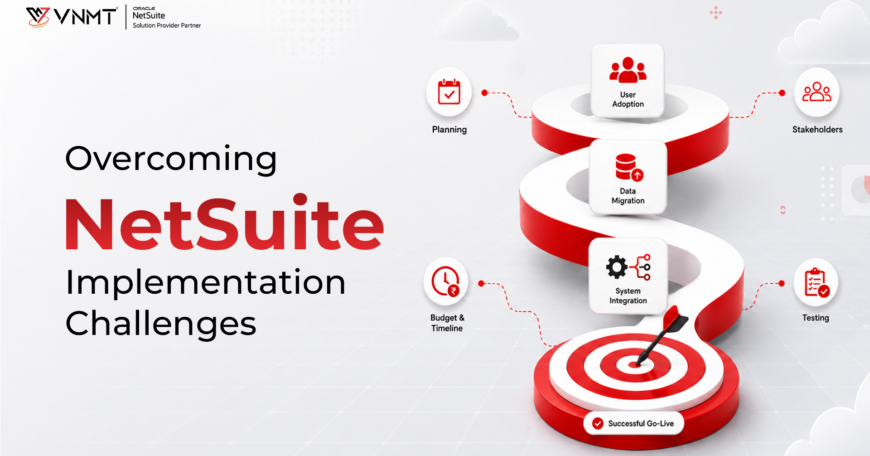
However, ERP deployment is not limited to software installation alone. It also involves organizational change, data migration, employee training, process alignment, and system integration. Poor planning in any of these areas can lead to delays, budget overruns, migration issues, and low user adoption. This is why understanding NetSuite implementation challenges before deployment is essential for businesses aiming for successful ERP adoption and long-term operational efficiency.
Common ERP Implementation Challenges
The implementation of an ERP system will influence almost every single department in a business firm. Since functions such as finance, procurement, inventory management, reporting, and business process flows are interrelated, any problem in the implementation of the ERP system will affect the firm’s efficiency in the long run.
Unclear Business Requirements and Poor Planning
One of the primary reasons for the failure of ERP implementation is the absence of well-defined business objectives. Companies implement ERP because they wish to undergo digital transformation but fail to determine their operational pain areas. In the absence of proper planning, companies often face-
- Departmental conflicting requirements, where financial departments emphasize automating reports, whereas operational departments prefer having inventory information and efficient workflows. This misalignment causes implementation delays and confusion.
- Frequent requests for customization at the time of deployment, as organizations discover what they actually need only when the deployment starts. Over-customization leads to complex implementations and increased implementation costs.
- Unstable project scope and timelines, which cause budgets to overrun and delays in deployments.
It is important for businesses to conduct requirement analysis prior to implementing any solution. Department stakeholders need to be involved in the process of finding the gaps within workflows, reporting, compliance, and automation requirements.
Extreme Data Migration Challenges
Migration of data continues to pose the most significant challenge during ERP migration since companies migrate information from spreadsheets, disparate applications, and other legacy systems to ERP. Inaccurate or out-of-date data can present many challenges to organizations after migrating to NetSuite.
Examples of some problems that may be encountered during migration include-
- Inconsistent and duplicate data, such as having inconsistent or duplicate customer information, vendor information, and/or product information, which can lead to poor reporting after implementation.
- Lack of historical data and traces, thus affecting forecasting and compliance requirements. Problems associated with the formatting and classification of data, especially for those that have used more than one application in managing their operations.
With regard to GST compliance and e-invoicing requirements in India, data migration becomes more crucial for organizations.
Employee Resistance and Low User Adoption
The ERP system tends to transform how employees carry out their daily operational activities, thereby causing resistance from those who are not familiar with new approaches and techniques.
Reasons why employees resist ERP implementation include the following-
- Resistance is caused by employees’ satisfaction with current operational processes and thus the difficulty of embracing new ERP methodologies.
- Fear of having to learn complicated software tools, especially in cases where there are inadequate training programs.
- Employees’ fears regarding any potential reduction in efficiency due to their initial inability to adopt new business processes.
Organizations that choose to ignore the opinions of employees tend to have poor ERP implementation results even when ERP is successfully implemented.
Budget Overruns and Unexpected Costs
Organizations tend to undervalue ERP implementation costs since they concentrate only on software licensing costs without taking into consideration other implementation costs.
The following can cause ERP budgets to rise-
- Customization needs that arise during implementation, making it more difficult and costly to implement and test.
- Migrating and integrating problems due to the utilization of obsolete and inefficient processes within the business.
- Project delays that result from poor planning and approvals, making the implementation process more costly than expected.
Indian companies should also factor in localization aspects like setting up their GSTs and enabling e-invoicing systems in their ERP budgets.
Integration and Compatibility Issues
Today’s enterprises use several different software solutions for managing their CRM, payroll, logistics, customer support, bank transactions, and e-commerce activities. Making these applications work with NetSuite can be hard when there are inconsistencies between API capabilities and data structures of the software solutions being integrated.
These integrations may produce-
- Inefficiencies in data synchronization, resulting in erroneous reports and delays in work.
- Need for manual data input, negating any benefits of automating operations.
- Lack of insight across business units due to non-integrated systems not enabling real-time reporting.
It is essential that companies establish all integration needs ahead of time and ensure compatibility of the chosen software solutions.
Read More: NetSuite Implementation Best Practices
Best Practices to Reduce ERP Migration Risks
Businesses can minimize difficulties associated with migration by conducting well-prepared and verified work.
1. Data cleaning must be performed prior to migration by eliminating duplicate records, updating outdated data, and aligning the structure of financial and inventory data.
2. A test migration must be conducted before the actual migration is performed, allowing companies to detect any missing data records, formatting errors, and incorrect reports during the process.
3. Companies must maintain backups to ensure that critical data for their operations is protected if something goes wrong during the migration process.
Validated data makes ERP more efficient and reliable, and these things can help your business grow faster than ever.
How Businesses Can Improve ERP Adoption
The success of ERP implementation depends on effective communication and consistent involvement of the employees.
- Companies need to organize specialized training for employees, explaining the ways through which ERP will make their work easier by improving process efficiency.
- There is also a need to designate ERP champions at the department level to assist employees within a team.
- Communication with management about the advantages that include automated processes and improved reports is essential.
When employees know the importance of implementing an ERP, it becomes much easier for them to adopt it.
Why Businesses Struggle With ERP Deployments
The challenges associated with ERP implementation arise from operational issues and lack of adequate planning rather than software inadequacies. Firms that consider ERP implementation simply as the process of deploying the technology often face problems with the implementation.
Inadequate Change Management
An ERP system involves a change in operations within various departments, and change management is important to ensure proper deployment. Failure to implement proper change management leads to-
1. Employees are still using old ways of doing things.
2. Departments find it difficult to work together during the transitional period.
3. Loss of productivity as a result of confusion about the implementation process.
Companies should concentrate on continuous communication among employees and role-based training programs during implementation.
Unrealistic Implementation Timelines
Most organizations assume that ERP will be implemented rapidly. This may lead to many operational challenges in the future. ERP Implementation involves several important steps, such as-
1. Requirement Analysis & Workflow Mapping
2. Customizing & Configuring
3. Data Migration & Validation
4. Integration & Testing
5. Training Employees
6. Post-go-live Optimization
Neglecting any of these phases may increase the risk associated with ERP implementation.
Poor Participation of Leadership
ERP initiatives necessitate high-level participation from leaders since their implementation impacts all operations within an organization. In the absence of leadership participation-
1. The department will be left to work independently.
2. It takes longer to make decisions, and these are inconsistent.
3. Priorities often change because of poor participation.
Leadership needs to be involved in ensuring coordination among different departments.
How a NetSuite Solution Provider Reduces Risk
An effective ERP implementation can be done by collaborating with a professional NetSuite solutions provider to minimize the associated risk factors. They ensure that companies overcome technical complexity, workflow alignment, and optimize ERP deployment.
The importance of their role is emphasized when it comes to dealing with the challenges faced by Indian businesses concerning compliance, scalability, and multi-site operations.
Strategic Implementation Of ERP
The expertise of professionals starts with comprehensive planning during the planning phase, involving-
- Identifying operational inefficiencies prior to implementation
- Establishing realistic expectations of the ERP system
- Focusing on areas of automation
- Eliminating confusion regarding implementation
Industry-Specific ERP Expertise
The type of industry will dictate the necessary ERP process flow and reporting requirements.
Examples include-
- Manufacturing requires production planning and stock management.
- Retail demands order tracking across all channels as well as warehouse coordination.
- Professional services involve project management and invoicing.
A seasoned NetSuite consultant takes these considerations into account and customizes the ERP system accordingly.
Identification and Risk Management
Risk Identification and Mitigation Services ensure that any associated risks are identified and addressed proactively. They assist organizations to manage-
- Errors during migration
- Compatibility challenges for integration
- Security and access management
- Configuration needs relating to compliance
Role of NetSuite Solution Providers in ERP Customization and System Integration
Customization and integration are important for NetSuite to match organizational needs. But too much customization will create future maintenance and scalability problems. Implementation providers with experience ensure that customization is effective and operationally viable.
Customized Workflow According to Organizational Process
Every business has its own workflow and reporting process. A NetSuite Implementation Provider assists organizations with customizing workflow for procurement approvals, automated financial reporting, inventory management, customer order management, and visibility into the executive dashboard. Proper customization enhances efficiency without increasing complexity.
Third-Party Applications Integration
Indian companies frequently make use of external applications to perform activities such as payroll management, logistics management, taxation, banking, and eCommerce activities.
Professional integration service providers will make sure that the integration between NetSuite and other applications is done efficiently and effectively, thereby enhancing visibility, coordination, and automation.
Post-Go-Live Support and Optimization
ERP Implementation is not over after deployment. It is necessary to provide ongoing support and optimization to get the most out of the ERP system and ensure ROI from it.
Ongoing User Training and Support
Employees usually require further assistance after the go-live phase, when they have to work with the ERP system in actual business settings. Post-deployment assistance should consist of-
- Help desk support for operations issues
- Training sessions
- Optimization suggestions
- Ongoing employee assistance
ERP Optimization on an Ongoing Basis
Business needs change continually, and so must ERP applications. It is important to assess-
- Workflow efficiency
- Reporting performance
- Stability of integration
- Productivity of users
- Efficacy of automation
Continual optimization helps organizations achieve optimal ERP usage.
Selecting the Right Partner for NetSuite Implementation
Choosing the right implementation partner is critical to the success of any ERP implementation initiative. An experienced partner not only makes the process easier but also prevents costly operational errors.
Consider Relevant Industry Knowledge
Organizations are encouraged to select partners that have knowledge in their industry because industry-specific knowledge ensures accuracy in implementation and process integration.
Consider Their Technical Skills
Implementation partners should be able to customize, migrate, integrate, automate, and configure ERPs to support compliance requirements.
Consider Post-Go-Live Services
Organizations must consider if their selected implementation partners will continue to provide support and services even after the implementation process.
Knowledge of Indian Compliance Requirements
ERPs for Indian organizations should have features such as GST compliance, e-invoicing, TDS management, and accounting standards.

Overcome NetSuite Implementation Challenges Now
NetSuite implementation can help businesses improve operational efficiency, reporting visibility, automation, and long-term scalability. However, successful ERP deployment depends on proper planning, process alignment, employee adoption, and continuous optimization. Challenges such as migration issues, integration complexity, budget overruns, and low user adoption can affect implementation success if they are not addressed early.
Businesses that identify ERP implementation risks in advance and follow structured deployment strategies are more likely to achieve smoother adoption and better operational outcomes. Ultimately, successful ERP implementation is not just about deploying software. It is about creating a scalable operational foundation that supports long-term business growth and efficiency.