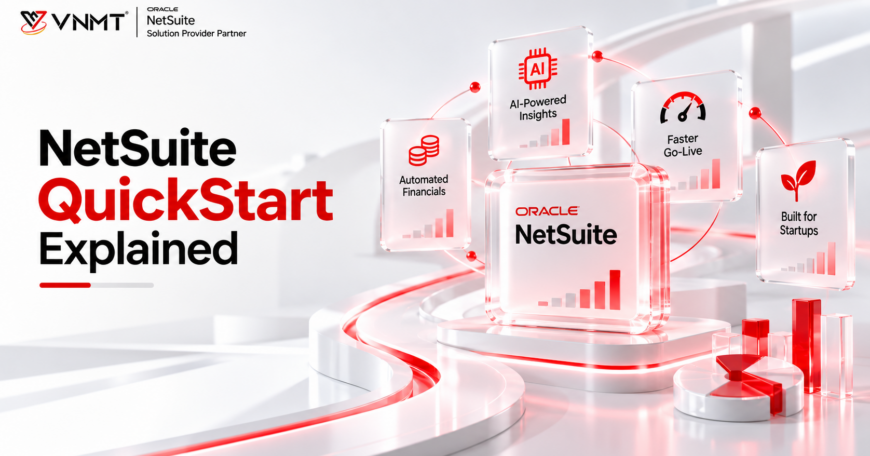

Many founders cannot say how many months of cash they have left. Spreadsheets cope while transactions are few, then fall behind, and decisions about hiring and spending get made on stale numbers. On 14 October 2026, Oracle launched NetSuite QuickStart, a free finance platform with AI built in, to fix that for early-stage technology startups.
One catch before anything else: Oracle has launched it for startups in the United States. If you are in Australia or India, you cannot assume you are eligible. This post covers what QuickStart includes, where its limits sit, and what any growing business can learn from it before moving to full NetSuite.
What is NetSuite QuickStart?
QuickStart is a self-service finance system for young technology companies. You connect a bank account, send an invoice, and see your financial position in minutes, with AI doing routine work in the background. It runs on Oracle Cloud Infrastructure, and Oracle positions it as the first step on a path to full NetSuite.
Oracle built it to fill a gap. A basic accounting app records income and expenses but gives a growing company a thin view of its finances. A full ERP gives that view but takes time and money many startups do not have yet. QuickStart sits between the two.
What Does NetSuite QuickStart Include?
Based on Oracle’s QuickStart page, the main parts are:
- Banking and reconciliation: bank and credit card feeds, with AI suggesting matches and categorising expenses, plus journal entries, tax tracking, and standard financial statements.
- Bills and invoices: vendor bills, purchase orders, quotes, sales orders, invoices, and customer payments.
- Subscriptions: recurring and usage-based billing, with SaaS metrics.
- Items and inventory: physical, service, and digital items, including inventory tracking.
- Ask Oracle and MCP: you can ask questions about your finances in plain language, connect ChatGPT or Claude, or work from Slack.
Startup Metrics in Plain Terms
QuickStart shows monthly recurring revenue (MRR), burn rate, and runway. MRR is the subscription revenue you earn each month. Burn rate is how much cash you spend each month, usually measured net of cash coming in. Runway is how long your cash lasts at that rate.
As an illustration only, a business with $600,000 in cash and a net burn of $50,000 a month has about 12 months of runway, if nothing changes. In practice, hiring, funding, and late payments all move that number, which is why founders want it updated constantly rather than quarterly.
Using AI on Your Finances
Ask Oracle lets a founder ask why costs went up or what needs attention, with answers drawn from the financial records. Oracle says QuickStart can carry out next steps, with your approval where needed. That only works if the records are clean and you decide in advance what the AI may do. Check permissions, connected apps, and approvals, and treat any figure going to an investor or advisor as a draft until a person has reviewed it.
Is NetSuite QuickStart Really free?
Yes, for eligible startups, within monthly limits that Oracle lists on its page:
- 2,500 business records, such as invoices, bills, sales orders, journal entries, subscriptions, customers, and items
- 800 emails
- 175 new documents
- 20GB of document storage
- Four connected bank and credit card accounts
- Two concurrent integration requests, including MCP
Monthly limits reset each month, and unused capacity does not carry over. A startup that invoices often or connects several tools should compare these numbers with its own volumes before relying on it.
Who Can Use NetSuite QuickStart?
Oracle describes the ideal user as a team of five or fewer people, operating as a single legal entity and looking for its first real financial system. If you have a larger team, several legal entities, international operations, or a need for more advanced financial controls, Oracle says full NetSuite may fit better.
In our view, size is only part of it. Your reporting needs, integrations, and expected transaction volumes matter just as much, so test them against the limits above.
Is QuickStart Available in Australia or India?
Not as announced. Oracle’s QuickStart page describes it as built for early-stage US technology startups, and we have not seen availability announced for Australia or India. Confirm eligibility with Oracle before you plan around it, and do not read the launch as free access for NetSuite customers everywhere.
When to Move From NetSuite QuickStart to Full NetSuite
A system that suits a startup can stop suiting it. A software company that begins with one entity and a handful of subscriptions may later add subsidiaries, enter new markets, offer more complex billing, or need consolidated statements.
Oracle says QuickStart gives a path into full NetSuite and that your data, workflows, and financial history move with you. How smooth that move feels still depends on how tidy your records are. Duplicate customer records and unreviewed user roles cause trouble in any NetSuite account, as our NetSuite Next readiness checklist explains. Confirm the details of the move with Oracle, especially if you have unusual configurations, integrations, or compliance needs.
Questions to Ask Before Choosing a Finance System
These apply whether you look at QuickStart or something else:
1. What needs to connect? List the systems for banking, invoicing, subscriptions, and reporting, and where the same data is typed twice. If your CRM and finance system share customers and deals, decide which one owns each record. Our HubSpot and NetSuite two-way sync case study shows how that mapping works.
2. Which metrics matter most? A subscription business watches MRR and runway. A product business also needs inventory, purchasing, and stock valuation.
3. Do the usage limits fit? Estimate your monthly records, documents, connected accounts, and integrations, and check that you have room to grow.
4. What controls do you need? Automation does not remove the need for review. Decide who checks AI-categorised transactions each week and who signs off numbers before they leave the business.
When you do plan a move, timing and cost are the next questions. Our guides to the NetSuite implementation timeline and NetSuite consulting rates are a good start.
Talk to VNMT About Your NetSuite Plan
VNMT Solutions implements, integrates, customises and supports NetSuite. Whether you are a startup choosing a first finance system or a growing business preparing for full NetSuite, we can help you plan the data, the integrations and the upgrade path. Contact our team to talk it through.

Conclusion
NetSuite QuickStart won’t change what our readers can sign up for; it’s a US-only product for early-stage startups. What it does show, clearly, is Oracle’s intended path from a free, AI-assisted setup through to a fully configured enterprise platform, and the exact points- transaction volume, document count, connected accounts, integration requests- where that path runs out of room. Those same checkpoints apply to any growing business, on any starting platform. The useful question isn’t whether you’re eligible for QuickStart. It’s whether you know where your own business sits against limits like these, and what a properly configured NetSuite setup needs to look like once you’ve crossed them.