
While NetSuite offers both CRM and ERP systems, this latest comparison stacks NetSuite against a CRM powerhouse known as Salesforce. With a NetSuite CRM consultant, it becomes easy for companies to implement various types of functionalities. One should note that a direct comparison is not possible because NetSuite is an ERP with CRM.
The competition between NetSuite and Salesforce has gained significant importance in recent years, considering the need for integrated cloud-based platforms to manage customer relations, automate business processes, and ensure scalability. Although both platforms have proved themselves successful in the market of enterprise software solutions, their focus areas and functions differ.
In particular, Oracle NetSuite represents an ERP-centric business management platform with a set of CRM tools, while Salesforce acts as a CRM-based ecosystem used for engaging customers and automating sales, among other activities. It is crucial to distinguish between NetSuite and Salesforce when choosing one of the two options.
Overview of Oracle NetSuite ERP Platform
The NetSuite ERP system from Oracle is a cloud-based ERP suite that encompasses accounting, finance management, inventory management, procurement, CRM, e-commerce, order management, and analytics into one single operational environment. Businesses don’t need to depend on separate applications for different functions, but rather run operations in a single operational space. Among the main advantages of NetSuite are financial management tools such as accounts payable, accounts receivable, budgeting, taxes, revenue recognition, and financial reporting.
The software allows businesses to automate accounting processes, improve reporting efficiency, and gain instant insight into the company’s finances thanks to dashboards. NetSuite has strong inventory management capabilities. It allows businesses to track inventory flow, fulfillment processes, and procurement operations. This feature can be especially useful for manufacturing, retail, wholesale, and e-commerce companies.
Overview Of Salesforce CRM
Salesforce is one of the leading providers of CRM platforms across the globe. This CRM platform deals with customer engagement, sales efficiency, marketing automation, customer service management, and customer lifecycle management. Salesforce enables businesses to manage customer interactions from leads to long-term customer support. The Salesforce platform allows businesses to manage leads, opportunities, pipeline, and customer engagement through a centralized CRM platform. This enhances transparency on how customers are acquired and the overall sales process. With Salesforce, companies can benefit from numerous automation capabilities designed to enable sales reps to automate processes, manage opportunities, and do better at forecasting.
Companies leverage the Salesforce platform for automating marketing campaigns, personalizing communication with customers, segmenting audiences, and evaluating campaign engagement. In addition to all these functionalities, Salesforce also offers customer service and support management capabilities.
What is the Difference Between NetSuite and Salesforce?
The main distinction between NetSuite and Salesforce can be seen in terms of the target business focus and architecture of the platforms. NetSuite is a cloud business management application that is aimed at facilitating the finance and accounting process, procurement and logistics, along with other business-related processes. Salesforce, on its part, is a CRM platform that concentrates on customer acquisition, sales automation, and marketing analytics and performance.
When making the choice regarding NetSuite ERP vs Salesforce solution, one should keep in mind that NetSuite emphasizes operational transparency and business management processes, while Salesforce places an emphasis on customer management and revenue generation.
One more difference between NetSuite and Salesforce platforms is related to their deployment structure. In particular, NetSuite features a more holistic approach by having ERP, accounting, CRM, e-commerce, and reporting functionality built into one single system. In the case of Salesforce, the deployment is based on the modular customer engagement platform. Thus, enterprises usually integrate third-party ERP solutions in order to cover operational activities.
NetSuite is More Inclined Towards:
Financial Management and Operational Control
NetSuite manages all finance-related areas such as accounting, budgeting, procurement, taxes, and even operations under one ERP environment. This results in improved financial and operational efficiency.
Inventory and Supply Chain Management
Companies with an inventory-centric nature tend to opt for NetSuite due to features like warehousing, automated procurement, supplier management, and fulfillment.
ERP Workflow Integration
One of the best aspects about NetSuite is that it allows the integration of all ERP functions. It enables finance, procurement, sales, inventory, e-commerce, and reporting to function in one business environment.
Global Business Operations
NetSuite is popular among businesses having a presence around the world due to multi-currency support, subsidiary management, tax compliance, and global consolidated reporting.
Salesforce Concentrates More On:
Customer Acquisition and Pipeline Management
Salesforce enables firms to enhance their processes around lead management, opportunities, customer acquisition, and visibility in sales.
Marketing Automation and Customer Engagement
The Salesforce CRM comes equipped with advanced marketing automation capabilities to allow personalized campaigns and automated customer communication.
Sales Automation and Forecasting
Salesforce CRM has earned a reputation among the top providers for sales automation capabilities such as lead scoring, sales forecasting, opportunities, and AI-powered sales insights.
CRM Ecosystem Flexibility
Flexibility in the ecosystem of applications, integrations, and workflows tailored to the individual customer needs is another key benefit of Salesforce CRM.
NetSuite & Salesforce Companies History
NetSuite was founded only months before the official release of Salesforce in 1998. The founder of NetSuite is Evan Goldberg. Quite interestingly, both organizations shared an early transformative view of what the cloud and SaaS model solutions can achieve. NetSuite has the unique distinction of being the first software company to emphasize cloud computing.
In its initial years, NetSuite targeted small and mid-size businesses with its ERP modules. Oracle eventually purchased NetSuite in 2016. The acquisition was quite interesting given NetSuite’s expertise in cloud architecture.
NetSuite was developed from scratch as a complete ERP, which includes CRM functionality too. From email marketing to real-time dashboards, you can avail it all with the help of NetSuite. That’s why you will need a NetSuite specialist to address the issues related to the deployment of the ERP.
Salesforce primarily focuses on CRM. The company’s Customer 360 platform provides a source that connects the data of the customers across various systems. Quite impressively, Salesforce emphasizes cloud, social, analytics, and AI.
The expertise of Salesforce in the latest technology platforms allows it to provide practical solutions to companies irrespective of their size. Salesforce also enables third parties to utilize its platform. It comprises a wide variety of developer-friendly tools.
The users of Salesforce usually rely on its sales offerings to store data and monitor leads. It also assists customers in resolving the routine issues associated with predictions and recommendations. NetSuite CRM implementation, when compared to Salesforce, usually requires more expertise.
Feature Comparison Of NetSuite vs Salesforce
1- Financial Management
The NetSuite application offers built-in ERP financial management tools such as accounting, budgeting, tax management, accounts payable, accounts receivable, and financial reporting. Operations and finances can be managed using a single system.
The Salesforce application lacks integrated ERP financial management tools and normally uses third-party ERP solutions to offer accounting and operations management services.
Best Choice: NetSuite
2- Customer Relationship Management
Salesforce is arguably among the best CRM systems that offer customer interaction, sales, and customer lifecycle management.
NetSuite CRM offers customer relationship management but gives more emphasis to operations alignment.
Best Choice: Salesforce
3- Inventory and Supply Chain Management
NetSuite offers superior inventory management, warehousing, procurement automation, and supply chain integration features.
Salesforce tends to rely on third-party ERP or integration solutions for its inventory and operations management features.
Best Choice: NetSuite
4- Sales Automation
Salesforce is great at sales automation with features such as lead scoring, sales forecasts, workflow automation, opportunity tracking, and intelligent customer insights.
While NetSuite has sales management functionality, it focuses more on operational than CRM automations.
Best Choice: Salesforce
5- Reporting & Analytics
NetSuite excels in financial reporting, operational analytics, procurement visibility, and ERP analytics.
Salesforce excels in customer analytics, sales reporting, marketing analytics, and customer engagement.
Best Choice: It Depends on Business Objectives
6- Ecommerce and Omnichannel Operations
NetSuite delivers superior operational management of e-commerce operations that includes inventory sync, order management, and fulfillment management.
Salesforce is better when it comes to digital commerce and customer engagement.
Best Choice: It Depends on Operational Needs
Oracle NetSuite vs Salesforce AI Capabilities in 2026
One of the key assessment parameters that companies use when evaluating enterprise software solutions is artificial intelligence.
In today’s business world, companies are relying on automation through AI, predictive analysis, smart reporting capabilities, and optimizing workflow processes.
Features of NetSuite AI
The Oracle company has integrated some additional AI features into NetSuite in order to improve operational and financial visibility within ERP workflows.
- The platform allows organizations to understand their operational trends and make accurate predictions about their financial situation using data analytics.
- Using AI assistance, organizations can automate the reporting process and gain operational insight.
- Using invoicing automation powered by NetSuite, organizations can reduce accounting workload.
- The platform offers intelligent workflow recommendations that help optimize business operations.
- NetSuite’s AI mainly specializes in operational intelligence, ERP automation, and financial management.
Salesforce Einstein AI
Salesforce continues to enhance its AI system with Salesforce Einstein AI and generative AI services aimed at customer engagement and productivity in sales.
- With the help of artificial intelligence, Salesforce can help organizations to identify sales opportunities that would be most valuable to them.
- With conversational AI solutions, organizations can automate customer communications and enhance engagement.
- Through intelligent sales suggestions, organizations can better manage opportunities and forecasts.
- Salesforce AI services help businesses personalize the experience of their customers with the help of engagement analytics and automation.
- Salesforce AI mainly concentrates on CRM intelligence and customer engagement services.
Platform Comparison: Lightning vs. SuiteCloud
Is NetSuite the Same as Salesforce?
This is a common question asked by many organizations. There are differences when you are comparing these two based on platforms. The Lightning platform of Salesforce allows the Salesforce partner ecosystem to develop and provide solutions via the App Exchange Marketplace.
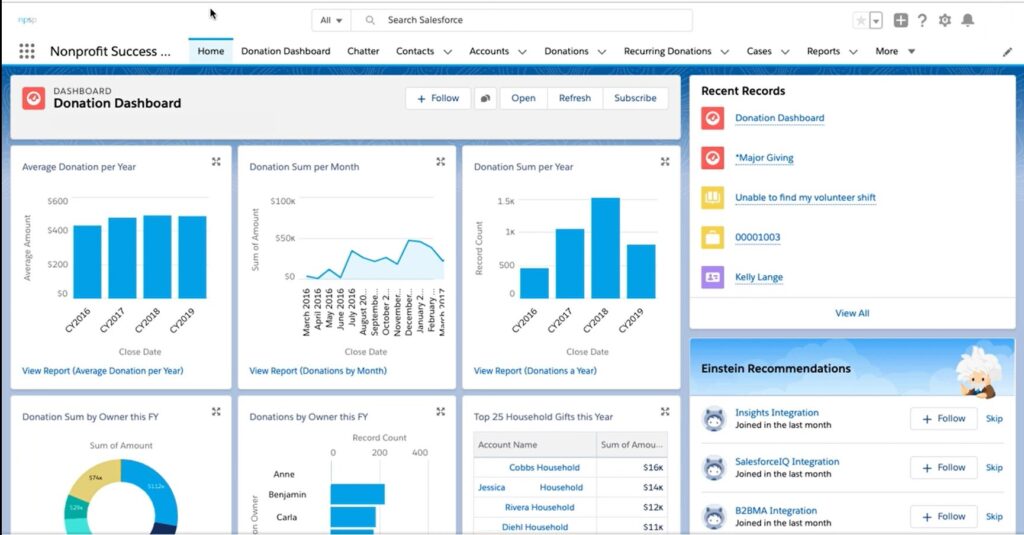
Note that the Lightning platform of Salesforce comprises more than a thousand vendors. The Salesforce platform also offers a comprehensive variety of extensions and plugins available to users. On the contrary, SuiteCloud, the dedicated forum for NetSuite, has its own App Exchange version.
This version is often known as SuiteApp. But when the context is about versatility, the SuiteApp platform of NetSuite lacks extensions and features when compared to the medium of Salesforce. Moreover, the SuiteApp platform comprises fewer partners and apps when compared to Salesforce.
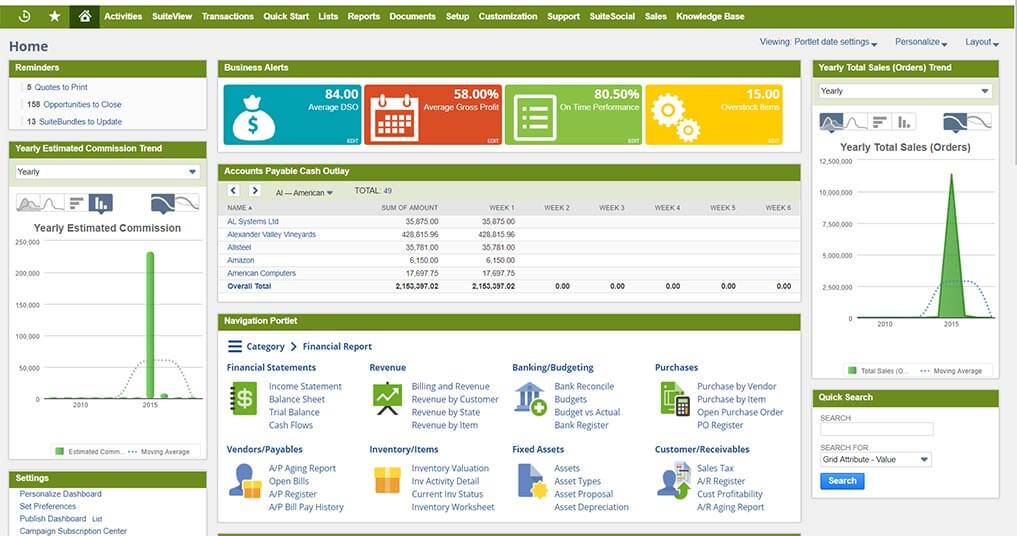
People usually wonder about NetSuite CRM pricing when opting for it. But remember that SuiteApp lacks features and functionalities because of the nature of the NetSuite solution. We all know that NetSuite provides an all-encompassing ERP and CRM function across multiple software segments.
On the contrary, Salesforce only specializes in providing CRM solutions. It often requires a large number of third-party extensions to integrate with your existing IT infrastructure. But at the same time, both these platforms are adept in providing users with a large number of personalization and extensions that exude practicality.
ERP Software Comparison: FinancialForce vs. NetSuite
FinancialForce is a series of products sitting on top of the Salesforce platform. As the name suggests, it offers a range of financial management and PSA products aimed at service-based organizations. Always remember that FinancialForce is not a sub-division of Salesforce. But it relies heavily on the Salesforce platform.
Which is Better, NetSuite or Salesforce?
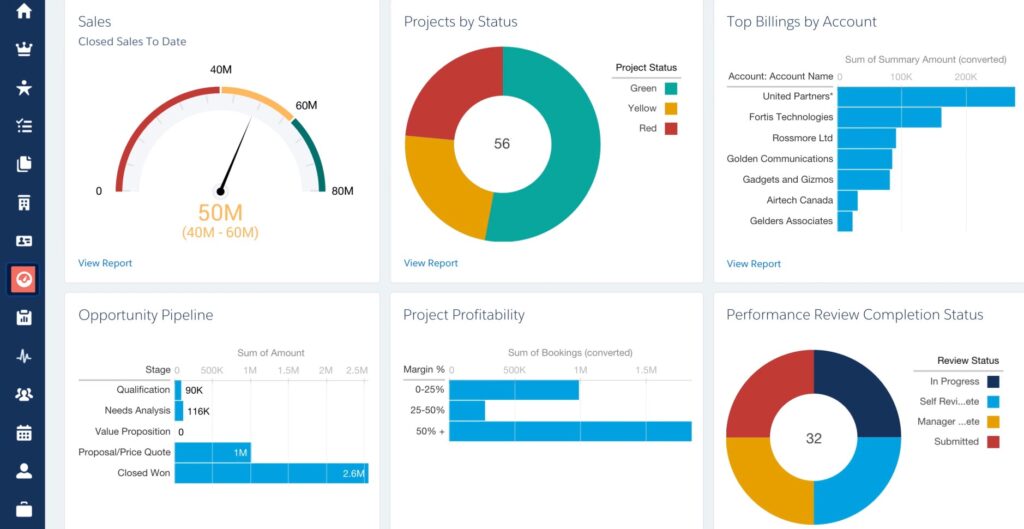
This is a common question asked by many users. Note that FinancialForce is ideal for large and professional organizations that already have implemented Salesforce. But at the same time, it works well for small businesses too that don’t have extensive requirements. In reverse, NetSuite can serve the needs of both small and large companies.
To be precise, there are few ERP platforms that can offer the same scalability as NetSuite. Quite impressively, the investment you make in the fully integrated NetSuite environment is ideal for financial management, supply chain, human capital, PSA, etc.
Is Salesforce an ERP or CRM?
Salesforce is a CRM solution used by a large number of companies nowadays. And as a large number of companies are using Salesforce and NetSuite, there is no way one can take their popularity.
CRM Software Comparison: Salesforce vs. NetSuite
When the context is about CRM, there is no denying the popularity of Salesforce. In recent years, Salesforce CRM has established itself as one of the most popular solutions to facilitate customer relationship management. Often, people go through a NetSuite CRM review to understand its capabilities.
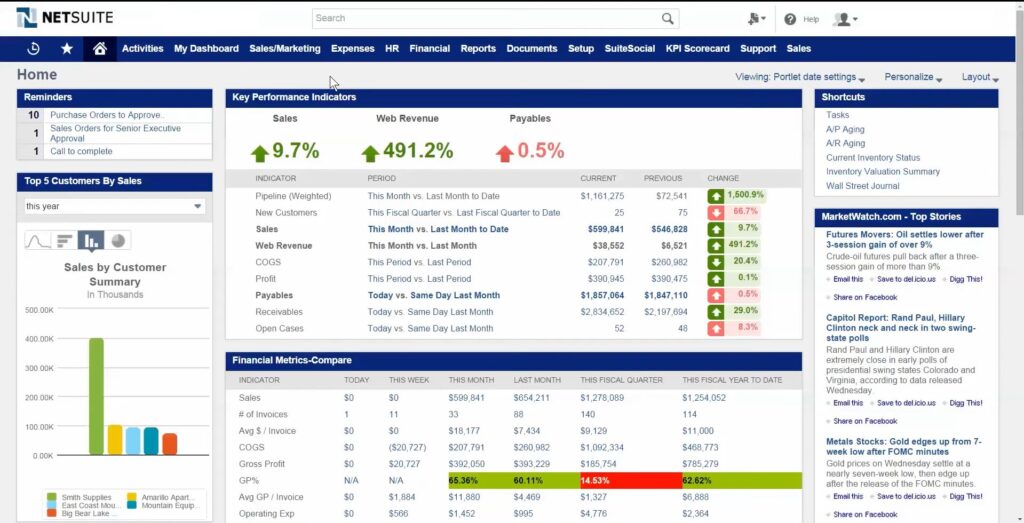
The CRM platform of Salesforce offers an intuitive UI along with a deep feature set. It also comes equipped with an analytics and reporting platform. With a versatile and robust provider of third-party integrations and extensions, Salesforce should always be on your top priority list as a versatile CRM platform.
While NetSuite CRM is an ideal option for small and mid-size companies, you cannot deploy it in large organizations. But if you are someone who loves to run your business from a single application and dashboard, then you cannot ignore NetSuite CRM.
With NetSuite CRM, you would be able to switch between support cases of the customer, buyer history, and real-time inventory. Hence, with the proper integration tools along with partners, the NetSuite CRM has the ability to outperform the CRM of Salesforce. Both NetSuite Salesforce integrations should require immense expertise.
NetSuite CRM vs. Salesforce: How Much Does it Cost?
The Oracle NetSuite vs. Salesforce comparison based on pricing is quite interesting. The price of NetSuite is customized based on each user’s preferences. It is also based on a set of given terms that includes ERP configuration. The base license for NetSuite ERP costs $999 per month, with access costs of $99 per user per month.
The NetSuite license usually operates as a subscription model and may be renewed annually or over longer intervals. On the other hand, Salesforce has various types of pricing. For instance, Lightning Essentials usually costs $25 per user per month. It allows up to five users. The Lightning Professional costs $75 per user per month.
The Lightning Enterprise costs $150 per user per month. Moreover, the Lightning total costs $300 per user per month. Salesforce has a separate pricing structure for its Service Cloud too. For Service Cloud:
- Lightning Professional costs $75 per user per month
- Lightning Enterprise costs $150 per user per month
- Lightning Unlimited costs $300 per user per month
Oracle NetSuite vs. Salesforce- Pros and Cons
Pros of NetSuite:
- It provides your organization access to streamlined information across the customer lifecycle.
- You can increase sales performance because of better forecasting and upselling.
Cons of NetSuite:
- NetSuite doesn’t use personal AI assistants.
- It doesn’t allow the integration of productivity tools.
Pros of Salesforce:
- You can use Salesforce as a strategic advisor.
- The Service Cloud of Salesforce has proved to be a great success.
Cons of Salesforce:
- The migration process and its implementation can be lengthy.
- Smaller enterprises wouldn’t be able to opt for Salesforce as it is costly.
What Do the CRM Experts Say?
When the context is about deploying either one of the software platforms, you have to rely on feedback. Let’s discuss the feedback of NetSuite first. NetSuite CRM is powerful, and it resides in the overall NetSuite ecosystem. In other words, it eliminates the requirement of paying for the operational expenses for two platforms.
Oracle NetSuite has gotten a deserved “visionary role” in Gartner’s ERP magic quadrant. Its CRM module has now attained an equal role within the CRM magic quadrant. NetSuite CRM is identified as a strong and sturdy CRM solution. It consists of capabilities in advertising automation, sales automation, and customer service.
Moreover, it supports a wide variety of customizations and integrations. On the other hand, Salesforce has a lot of loyalty from its user base. The platform is quite powerful and relatively easy to use. It is also incredibly extendable. Moreover, the customer service of Salesforce is top-notch.
Factors That Decide Pricing (NetSuite vs. Salesforce)
In comparing the NetSuite vs. Salesforce pricing factors, companies need to focus on the value of each solution beyond just the subscription price alone. Implementation requirements, integration needs, customization, and scalability all affect the cost of ownership.
Important Pricing Factors are-
For NetSuite pricing: NetSuite pricing typically depends on several business factors, including the ERP modules selected and the number of users requiring platform access.
- ERP modules and functionalities selected
- Number of users requiring platform access
- Implementation complexity and deployment scope
- Workflow customization requirements
- Third-party integrations and system connectivity
- Operational scale and business structure
- Reporting, analytics, and automation needs
- Ongoing platform management and support requirements
For Salesforce Pricing: Salesforce pricing is generally influenced by the cloud products a business chooses
- Cloud products and services selected.
- Platform editions and user tiers required
- Number of users and access levels
- Additional add-ons or advanced capabilities
- Automation and workflow management features
- Analytics and reporting functionality
- Integration and customization requirements
- Customer engagement and service management needs.

Which Platform has Customization and Workflow Flexibility
Both of these systems have strong capabilities for customizing applications, but each system has different focuses. Customization in NetSuite is ERP and operations-based through SuiteCloud, whereas customization in Salesforce is CRM-based through the Lightning platform. It is recommended that organizations assess their own customization needs based on workflow preferences.